Key points on epoxy systems for composites
- The choice of epoxy systems must start from the production process and the performance required of the component.
- Resin and hardener form a system: by changing the combination, workability, viscosity, reactivity, and Tg can vary.
- Pot life, gel time, viscosity, cure cycle and Tg are central parameters in the selection.
- Hand lay-up, compression molding, RTM, infusion, filament winding, and pultrusion require different characteristics.
- The Huntsman Araldite® range includes epoxy systems formulated to meet different processes and application requirements.
When talking about epoxy resins for composite materials, focusing exclusively on the base resin is not enough to identify the most suitable solution.
Behavior during processing and the characteristics achievable after hardening depend on the epoxy system, i.e., the combination of resin, hardener and any accelerators.
The same resin can therefore be used within different systems, modifying parameters such as viscosity, pot life, gelation, cure cycle, and glass transition temperature. For this reason, the choice of epoxy systems for composites should first and foremost start with a question: with which process will the component be made?
The Huntsman Araldite® range includes epoxy systems formulated for:
- hand lay-up;
- compression molding;
- RTM;
- infusion;
- winding process
- pultrusion.
Resin systems for composites with different characteristics depending on production conditions and required performance.
Index
- What are epoxy systems for composite materials
- Why the same resin can give rise to different epoxy systems
- Which parameters to consider when choosing epoxy systems
- Epoxy systems for hand lay-up
- Epoxy systems for compression molding
- Epoxy systems for RTM
- Epoxy systems for vacuum infusion
- Epoxy systems for filament winding
- Epoxy systems for pultrusion
- Which epoxy system to use for each process
- Liquid epoxy systems, prepregs, and adhesives: what are the differences
- Applications of epoxy systems in composite materials
- How to choose the most suitable epoxy system
- Frequently asked questions about epoxy systems
- Mascherpa support in choosing Araldite® epoxy systems for composites
What are epoxy systems for composite materials
An epoxy system used in the production of composite materials does not coincide with the resin alone.
The formulation can include:
- epoxy resin;
- hardener;
- any accelerator.
The combination of the different components determines the behavior of the system during processing and the characteristics achievable after hardening. This is the reason why two systems based on the same resin can be suitable for different production processes.
Why the same resin can give rise to different epoxy systems
The example of Araldite® LY 1564 resin allows us to concretely understand this principle.
Combined with XB 3403 hardener, the formulation features a long pot life and low viscosity. Characteristics that make it perfect for processes such as hand lay-up and infusion.
In the Araldite® LY 1564 / ARADUR® 3486 system, the profile changes. The system maintains a long pot life and low viscosity, but is highly recommended for infusion and also recommended for other processes.
With ARADUR® 5003-1 changes the behavior again: the system features a pot life of 42-52 minutes, a gel time of 6-8 minutes and is highly recommended for molding a molding and RTM.
The starting resin is the same, but the hardener, system characteristics, and processes for which the formulation is most suitable change. It is therefore more correct to speak of epoxy system selection than simply choosing the resin.
Which parameters to consider when choosing epoxy systems
The process represents the first filter, but it is not enough on its own. Two epoxy systems usable in the same process can in fact present very different characteristics. The selection must therefore relate the production conditions to the parameters of the formulation.
Pot life of epoxy systems
The pot life indicates the window during which the system maintains a workability compatible with the specified conditions. The duration required changes depending on the processing and the dimensions of the component.
A small component can be impregnated in relatively short times. On much larger structures, however, the system must remain workable long enough to allow the resin to reach all intended areas before the progress of the reaction interferes with the process.
This aspect assumes particular importance in infusion, filament winding processes and in continuous processing.
Gelation time (gel time)
The gel time describes the time required, in the line of tests indicated, for the system epoxy to reach gelation e losing progressively its ability to flow.
It must not be confused with pot life: the two values describe related but different aspects of the system’s reactivity. In an infusion process, for example, the resin must be able to travel through the component and impregnate the reinforcements before gelation prevents the completion of the flow.
Mixture viscosity of epoxy systems
The viscosity influences the behavior of the resin system during impregnation, injection and flow through the reinforcements.
In liquid processes, it is therefore an essential parameter, but it must not be evaluated in isolation. A reduced viscosity can favor impregnation, but the formulation must simultaneously offer pot life, reactivity, and a cure cycle compatible with the geometry of the component and the process used.
Cure cycle in epoxy systems
Every epoxy system provides for certain line of polymerization. Temperature e longevity of the cycle must be compatible with the production process, with the equipment available and with the characteristics to be achieved on the part.
Araldite® LY 3031 / ARADUR® 3032, for example, is a fast-curing system formulated for mass production by compression molding, with a cycle of 30 seconds at 140 °C.
Glass transition temperature
The Tg, glass transition temperature, is one of the parameters used to distinguish systems intended for different thermal requirements.
Approaching and exceeding the glass transition zone, the polymeric material progressively modifies its behavior and loses part of the rigidity characteristic of the glassy state. The Tg must therefore be evaluated in relation to the expected temperature during the use of the component, without separating it from the cure cycle necessary to reach it.
Within the Araldite® range there are epoxy systems with very different Tg values, from formulations in the order of 70-80 °C up to systems that exceed 200 °C, intended for different application requirements.
Epoxy systems for hand lay-up
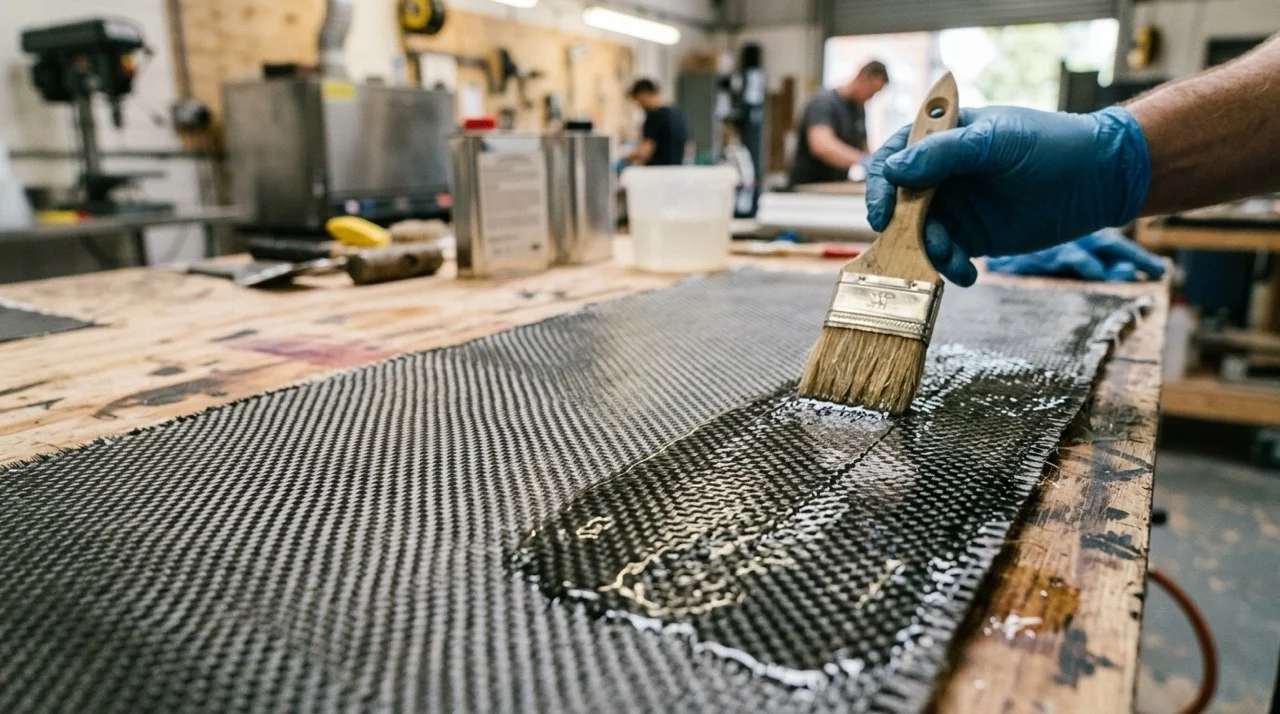
In hand lay-up the resin is applied and distributed on the reinforcements during the construction of the laminate. The system must allow the operator to correctly complete impregnation and layering before the progress of the reaction reduces workability.
For this reason Huntsman includes formulations characterized by extended pot lives.
- Araldite® LY 3505 / Hardener XB 3403 is highly recommended for hand lay-up and is described as a high latency system. It features a pot life of 600-720 minutes and a mixture viscosity of 300-400 mPa·s.
- Araldite® LY 1564 / Hardener XB 3403 is highly recommended for this process and combines a pot life of 870-1050 minutes with a viscosity of 150-230 mPa·s.
There is therefore no single system for hand lay-up: the choice depends on operating times, component geometry, reinforcements, and required performance.

Epoxy systems for compression molding
Compression molding can require very different logics, especially when the goal is to increase productivity and reduce cycle time.
The Araldite® range includes epoxy systems formulated specifically for rapid production.
- Araldite® LY 3031 / ARADUR® 3032 recommended by Huntsman for compression molding and is described as a fast-curing system for mass production.
- Araldite® LY 3508 / ARADUR® 3475 instead combines fast curing and high toughness and is suitable for the mass production of composites.
In these processes the epoxy system must therefore be evaluated by relating forming time, mold temperature, reaction speed, and final performance.

Epoxy systems for RTM
In Resin Transfer Moulding i , die are positioned in the mold and resin is subsequently transferred inside the cavity. The ability of the system to flow through the preform and process control of the reaction during filling e hardening.
Araldite® LY 1564 / ARADUR® 5003-1 is one of the clearest examples: the system is recommended for RTM and compression molding, features a pot life of 42-52 minutes and is characterized as very fast. Other systems instead allow working with wider time windows or reaching higher Tg.
The correct formulation must be chosen considering geometry, thickness, preform structure, pressure, temperature, and time required for complete mold filling.
In the RTM Light process the resin is similarly transferred inside a closed mold, but with a vacuum-assisted configuration and low injection pressure. In this case too, correct flow management is decisive for impregnating the reinforcements and obtaining the intended laminate.

Epoxy systems for vacuum infusion
In the infusion i , die are positioned on the dry mold and resin is subsequently drawn through the laminate thanks to the vacuum created by the vacuum system. During this phase the mixture must remain sufficiently fluid and workable to reach the entire surface and impregnate the reinforcements before gelation.
It is precisely here that the relationship between viscosity, pot life and gel time becomes particularly evident.
Araldite® LY 1564 / ARADUR® 3486 is perfect for infusion. The system features a viscosity of 200-300 mPa·s, a pot life of 560-620 minutes and a gel time of 33-43 minutes in the respective test conditions.
The sizing of the process window also depends on the part. A small infusion can be completed quickly. On a hull or other large structure, however, the resin front must travel greater distances and the system must remain workable for as long as necessary to complete the impregnation.
For this reason, selection cannot be based exclusively on the lowest viscosity or the highest Tg.
Araldite® epoxy systems in the infusion of the Alba skiff
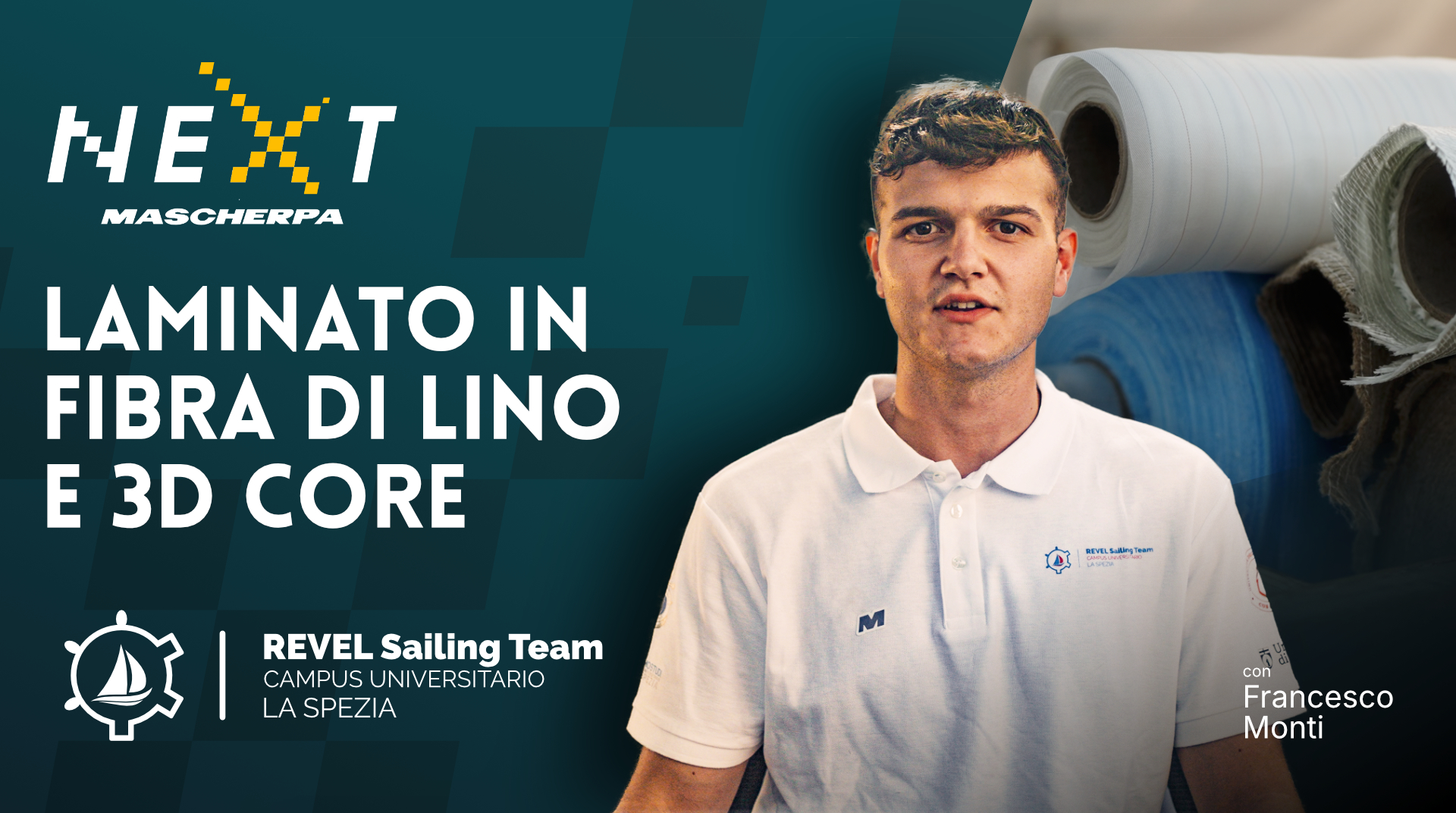
A concrete application of epoxy systems in infusion is the Alba skiff by the Revel Sailing Team, made through a vacuum infusion process.
For the hull lamination, Araldite® LY 5052 MBC was used, a low-viscosity Huntsman epoxy resin supplied by Mascherpa, used with Saertex flax and glass reinforcements and a 3D Core in recycled and recyclable PET.
The formulation was chosen within a project also oriented towards reducing the impact of materials, thanks to the use of ingredients derived from biomass and REDcert² certification.

Epoxy systems for filament winding
In filament winding the fibers are wound around a mandrel according to defined angles. In this process the fibers are impregnated with the epoxy system during processing. The behavior of the formulation must therefore remain stable during impregnation and winding, to then allow the correct polymerization of the component.
The Huntsman Araldite® range includes several epoxy systems suitable for filament winding.
Araldite® LY 1564 / ARADUR® 917-1 / Accelerator 960-1, for example, is often chosen for the winding process and for pultrusion. Other formulations allow modulating Tg, viscosity, latency, and cure cycle in relation to the component’s characteristics.
The filament winding is particularly used in the production of axisymmetric components e systems extreme conditions pressure, where orientation of fibers, reinforcements e epoxy system must be designed as elements of the same process.
Epoxy systems for pultrusion
The pultrusion is a continuous process in which fibers e other reinforcements are impregnated with the resin system e pulled through a heated die. The formulation must remain workable during feeding and impregnation, but must also react with a speed compatible with the passage inside the die.
This makes it particularly important to combine:
- pot life sufficiently long;
- viscosity suitable for impregnation;
- gelation and reactivity compatible with line speed;
- adequate thermal cycle;
- Tg and performance consistent with the component.
Araldite® LY 3585 / ARADUR® 917-1 / Accelerator DY 080 is recommended for pultrusion. Huntsman indicates a pot life of more than 48 hours and a gel time of 15-20 seconds at 180 °C.
It is an effective example of how a formulation can combine long workability in the initial stages with a much faster reaction when the necessary temperature is reached during the process.

Which epoxy system to use for each process
| Process | Example of Araldite® system | Main characteristic |
| Hand lay-up | Araldite® LY 3505 / Hardener XB 3403 | High latency system for hand lay-up |
| Hand lay-up | Araldite® LY 3297 / ARADUR® 3298 | Good mechanical properties after curing at 23°C |
| Hand lay-up | Araldite® LY 5052 / ARADUR® 5052 | Very good mechanical properties after curing at 23°C. Aerospace qualified |
| Compression molding | Araldite® LY 3031 / ARADUR® 3032 | Fast-curing system for mass production in compression molding |
| Compression molding | Araldite® LY 3508 / ARADUR® 3475 | Fast curing and high toughness for mass production |
| Compression molding | Araldite® LY 3585 / ARADUR® 3475 | Fast curing for mass production |
| RTM | Araldite® LY 1564 / ARADUR® 5003-1 | Very fast |
| RTM | Araldite® LY 3508 / ARADUR® 3486 | Very high toughness |
| RTM | Resin XB 3518 / ARADUR® 22962 | Medium Tg, high elongation at break |
| Infusion | Araldite® LY 1564 / ARADUR® 3486 | Long pot life and low viscosity |
| Infusion | Araldite® LY 1568 / ARADUR® 3489 | Low exothermic behavior |
| Infusion | Araldite® LY 1583 / ARADUR® 3495 | Longer pot life and higher Tg compared to Araldite® LY 1564 / ARADUR® 3486 |
| Filament winding | Araldite® LY 1564 / ARADUR® 917-1 / Accelerator 960-1 | Anhydride hardener, low temperature curing |
| Filament winding | Araldite® LY 3585 / ARADUR® 3486 | Long pot life, medium Tg system |
| Filament winding | Araldite® LY 1564 / ARADUR® 3474 | Medium pot life, medium viscosity, and high elongation. Suitable for pressure systems |
| Pultrusion | Araldite® LY 3585 / ARADUR® 917-1 / Accelerator DY 080 | Designed for pultrusion with better part quality compared to DY 070 systems and with accelerator 960-1 |
| Pultrusion | Araldite® LY 1564 / ARADUR® 917-1 / Accelerator 960-1 | Anhydride hardener, low temperature curing |
| Pultrusion | Araldite® LY 1135-1 / ARADUR® 917-1 / Accelerator 960-1 | Medium Tg, long pot life anhydride hardener system |
Liquid epoxy systems, prepregs, and adhesives: what are the differences
The epoxy systems used in composites do not all belong to the same application family.
Huntsman distinguishes between:
- systems formulated for liquid processes;
- systems formulated for prepregs;
- epoxy binders for RTM preforms;
- adhesives for structural assemblies;
- adhesives for assembly and repairs.
This distinction is also important when analyzing processes such as debulking.
Debulking is a compaction phase used especially in the processing of laminates and prepreg materials. In this case, the focus is not therefore the selection of one of the liquid systems described in the previous paragraphs, but the management of compaction and the materials used in the lamination cycle.
Correctly separating these families allows avoiding considering systems developed for different processes and needs as equivalent.
Applications of epoxy systems in composite materials
Epoxy systems for composite materials are used in various industrial sectors.
- In aerospace and defense, composites are used when it is necessary to combine weight containment, mechanical performance, and specific production, maintenance, and repair requirements. Within the range, Araldite® LY 5052 / ARADUR® 5052 is an aerospace qualified system.
- In automotive, the cited applications include pressure systems, leaf springs, bodies, wheels, and battery housings. Here the choice of the system must also be reconciled with productivity and process repeatability.
- In the marine sector, composite materials find application from pleasure boats to racing hulls and large vessels, where lightness and mechanical performance must coexist with severe operating conditions.
- In sports, weight, strength, flexibility, and fatigue behavior are decisive parameters for applications such as skis, rackets, bows, and bicycles.
There is therefore no single epoxy system intended for a single market, but formulations to be selected based on the interaction between process, component, and required performance.
How to choose the most suitable epoxy system
The correct path starts from the component and the process.
It is first necessary to define how the part will be produced, what processing times are available, what temperatures can be reached, and what characteristics the component must maintain during use.
At that point it is possible to compare systems through parameters such as:
- compatibility with the process;
- pot life;
- gel time and reactivity;
- viscosity;
- cure cycle;
- required Tg;
- mechanical and fracture properties;
- specific application requirements.
The system with the highest value in a single column is not necessarily the most suitable. The formulation must work correctly in the real process considered as a whole.
Frequently asked questions about epoxy systems
What is meant by an epoxy system?
An epoxy system is a formulation that can include an epoxy resin, a hardener, and any accelerators. The combination of components determines the behavior during processing and the characteristics obtainable after hardening.
Can the same resin be used in different epoxy systems?
Yes. The same resin can be combined with different hardeners to give rise to systems with different viscosity, reactivity, pot life, Tg, and process destinations. Araldite® LY 1564 represents a clear example within the Huntsman range.
What is the difference between pot life and gel time?
Pot life indicates the window during which the system maintains a workability compatible with the specified conditions. Gel time instead measures the time required, in the indicated test conditions, for the system to reach gelation.
Why is Tg important in choosing an epoxy system?
The glass transition temperature helps evaluate the thermal behavior of the cured material. It must be considered in relation to the expected operating temperature, the cure cycle, and other required performance.
How do you choose the most suitable Araldite® epoxy system?
The selection must start from the production process and consider together component geometry, reinforcements, available times, viscosity, reactivity, polymerization cycle, Tg, and required mechanical properties.
Mascherpa support in choosing Araldite® epoxy systems for composites
The variety of available formulations allows adapting epoxy systems to very different processes and requirements, but makes a correct selection phase equally important.
Mascherpa supports companies in identifying the Araldite® systems most consistent with the production process, the reinforcements used, the processing conditions, and the properties required of the component.
The goal is not to identify a resin based on a single technical data point, but to build a consistent combination of epoxy system, production process, and final application.
Contact us to evaluate the Araldite® system best suited to your composite material production process.