Skip to main content
Premi Invio per effettuare la ricerca o ESC per chiuderla
Search
Close Search
search
Menu
Who we are
Fondazione Alberto Mascherpa
Associations
DGE Partners
Quality
Product Guide
Brands
Special lubricants
Condat
Electrolube
Emax
Krytox
Molykote
Petro Canada
Tecnite
Ambersil
Industrial adhesives
Araldite
H.B. Fuller | Beardow Adams
Dupont
Betaforce
Betamate
Betaclean
Betafill
Betalink
Betaprime
Betaseal
Betawipe
Dowsil
Huntsman
Merbenit
Silastic
Superbond
Tecnite
Tecbond
Electronic Protection
Dowsil
Araldite
Electrolube
Sylgard
Arathane
Composites
3D-Core
Nidaplast
Araldite
Diatex
Saertex
Ecotechnilin
Ren®
Mechanics
Adcole
Airpot
Airpel
Ambersil
Camloc
Cytec
Devcon
Fitlock
Hahn
Koba
Kyntronics
Naxos Diskus
Soon Black
Brands
Industries
Automotive
Interior and bodywork
Engine chassis and brakes
Chemistry
Composite
Home appliances
Electronics
E-mobility
Advanced Driver Assistance Systems
Battery system
Electric Drive systems
Power conversion system
Energy
Wind energy
Solar energy
General industry
Heavy industry and steel mills
Lighting
Marine
Transportation
Commercial transportation
Trains and railways
Industrial Lubricants
Lubricants
Industrial Lubricants
Product catalog
Brands
Molykote
Krytox
Petro Canada
Electrolube
Condat
Product type
Greases
Pastes
Antifriction coating
Compound
Oils
Applications
High temperatures
Anti-noise
Electrical contacts
Bearings
Gaskets and O-rings
Plastic gears
Biodegradable lubricants
Food machinery
Valves and fittings
Screws and threaded connections
Applications
Technology
Silicone
Fluorosilicone
Perfluoropolyether (PFPE)
Polyalphaolefin (PAO)
Polyalkylene glycol (PAG)
Hydrotreated mineral
Ester
Thickeners
Calcium sulfonate
Aluminum complex
Lithium
Industrial Adhesives
Adhesives
Industrial Adhesives
Product catalog
Brands
Dowsil
Araldite
Betamate
Merbenit
Born2Bond
Product Type
Elastomeric adhesives
Silicone sealant adhesives
Polyurethane sealant adhesives
MS Sealing Adhesives
Structural adhesives
Epoxy adhesives
Methacrylic adhesives
Polyurethane adhesives
Acrylic adhesive
Tipi di prodotto
Hotmelt
Hot-Melt Packaging BAMFutura™
Hot-Melt pressure sensitive Pressen™
Hot-Melt product assembly Prodas™
Anaerobic adhesives
Instant cyanoacrylate adhesives
Surfaces
Plastic
Composites
Metals
Electronics
Electronics
Electronics
Catalogo prodotti
Brands
Dowsil
Araldite
Electrolube
Sylgard
Arathane
Product type
Electronics stickers
Resins and encapsulants
Gel
Conformal coating
Thermally conductive materials
Thermally conductive pastes
Heat-conductive adhesives
Gap filler
Composites
Composites
Composites
Brands
3D-Core
Araldite
Diatex
Nidaplast
Saertex
Ren®
Product types
Core materials
Modeling resins
Molding consumables
Resin systems for composites
Reinforcement Fabrics and Pre-Pregs
Mechanics
Mechanics
Mechanics
Brands
Adcole
Airpel
Airpot
Cytec
Fitlock
Link 2
Hahn
Koba
Kyntronics
Naxos Diskus
Mechanical components
Actuators and Cylinders
Shock Absorbers and Dampers
Gas Springs
Locking Systems
Panel fastening systems
Machine tool equipment and accessories
Measuring Machines
Abrasive tools
Abrasive Grinding Wheels
Blog
🍃 Sustainability
linkedin
Contact
search
🧭 Where you are:
mascherpa.it
»
Glass
Glass
Home
Product Substrati
Glass
Mostra
Nascondi
Filtri
Showing 1–20 of 68 results
Default sorting
Sort by popularity
Sort by latest
Sort by price: low to high
Sort by price: high to low
Filtri
Close Filters
Read more
Quick View
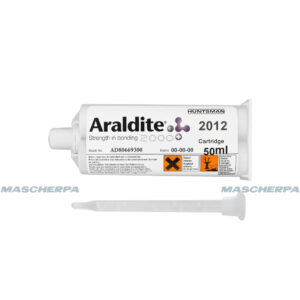
ARALDITE® 2012-1
Two-component epoxy adhesive for fast bonding
Versatile solution for general-purpose applications
Suitable for bonding a wide variety of materials
High strength and toughness
Fluid consistency for easy application
Also suitable for potting small components
Formulated without intentionally added BPA
Not subject to CMR labeling
Read more
Quick View
ARALDITE® 2013-2
Two-component epoxy adhesive for high-strength bonding
Specifically designed for bonding metals and rigid materials
Good resistance to environmental and chemical agents
Suitable for vertical applications thanks to its sag resistance
Suitable for multi-material bonding
High strength and toughness
Suitable for gap filling
Formulated without intentionally added BPA
Not subject to CMR labeling
Read more
Quick View
ARALDITE® 2020-1
Two-component transparent and colorless epoxy adhesive
Low viscosity for high flowability
Particularly suitable for bonding glass and ceramic
Suitable for transparent casting, laminates and component encapsulation
Refractive index similar to glass
Good water resistance
Suitable for transparent assemblies and electronic applications
Formulated without intentionally added BPA
Not subject to CMR labeling
Read more
Quick View
ARALDITE® AV 138 M-2
Two-component epoxy adhesive for high-strength industrial bonding
High chemical resistance
Excellent performance at high temperatures
Suitable for aggressive operating environments
Thixotropic and suitable for gap filling
Suitable for multi-material bonding
Suitable for heavy-duty industrial applications
Formulated without intentionally added BPA
Not subject to CMR labeling
Read more
Quick View
BETACLEAN™ 3900
Solvent-based cleaner for removing dirt and grease residues from glass, paint and plastic.
Read more
Quick View
BETAFILL™ 10210
They are excellent sealants for automotive repair.
They allow gluing, grouting and sealing.
Compatible with almost all paint systems.
DOW AUTOMOTIVE products are developed in collaboration with the houses
automotive.
Read more
Quick View
BETAFILL™ 10211
They are excellent sealants for automotive repair.
They allow gluing, grouting and sealing.
Compatible with almost all paint systems.
DOW AUTOMOTIVE products are developed in cooperation with automakers.
Read more
Quick View
BETAFILL™ 10215
They are excellent sealants for automotive repair.
They allow gluing, grouting and sealing.
Compatible with almost all paint systems.
DOW AUTOMOTIVE products are developed in cooperation with automakers.
Read more
Quick View
BETAMATE™ 1100N-1F
Excellent adhesion to automotive steels
It helps to increase or restore the stiffness and impact stability of the entire car body.
High durability of the adhesive bond
Protects metal and welding spots from corrosion
Compatible with other mechanical and thermal joining techniques
Read more
Quick View
BETAMATE™ 7120
Cold workable
Medium viscosity
Low modulus adhesive Excellent UV stability characteristics
Solvent-free, for direct glazing applications.
It exhibits excellent elasticity.
Read more
Quick View
BETAPRIME™ 5026
Primer that promotes adhesion laminated glass and enameled substrates.
Can be used in conjunction with Dow Automotive Systems adhesives/sealants.
Used without pretreatment with wipes
Compatibility with coated polycarbonate substrates
Read more
Quick View
BETASEAL™ 1001EM
One-component adhesive that cures at room humidity
For direct glazing applications.
Excellent stability
Cord stability
Skin formation and hardening depend on humidity, temperature and size
Safety time of 3 hours
Read more
Quick View
BETASEAL™ 1130
One-component adhesive that cures at room humidity
For direct glazing applications.
Excellent stability
Cord stability
Skin formation and hardening depend on humidity, temperature and size
Safety time of 2 hours
Read more
Quick View
BETASEAL™ 1812
It has high viscosity and medium modulus that can be used without primer on paints for selected painting technologies.
Provides high initial handling force to maintain the position of bonded parts.
Solvent-free.
It shows excellent stability of the bead and sagging effect.
Skin formation and curing depend on the humidity, temperature and size of the application.
Read more
Quick View
BETASEAL™ 1965-1F
It has a wide application coverage and can also be used without primer on automotive paints.
It exhibits excellent sag and bead stability.
Skin formation and curing depend on the humidity, temperature and size of the application.
Read more
Quick View
BETASEAL™ 8000-1F
Medium viscosity, low modulus glass adhesive with excellent UV stability characteristics.
It can be used without primer on the paint for some paint technologies.
Solvent-free
It shows excellent stability to sagging and chords. Skin formation and curing depend on humidity, temperature, and application size.
Read more
Quick View
BETAWIPE™ VP 04604
Activator for screen printing on glass and ceramics.
Pretreatment of bonding surfaces before application of BETAPRIME and BETASEAL/BETAMATE E
Read more
Quick View
DOWSIL™ 1200 OS Primer
Improves adhesion of silicone sealants to many substrates
Provides more uniform and stronger bonds
Complies with South Coast and Bay standards
South Coast and Bay Area Air Management District.
Primer for architectural sealants
Low VOC at 76 g/l
Formulated for low toxicity
The OS solvent used does not deplete the ozone layer. OS = Ozone Safe
The primer is suitable for Waterproofing and structural applications for glazing applications
Read more
Quick View
DOWSIL™ 3-6096 Adhesive
Addition curing system
Cures into a durable and flexible rubber
Excellent adhesion to a wide range of substrates such as glass, metals and plastics
Rapid thermal polymerization
Excellent heat resistance (up to 250ºC)
Read more
Quick View
DOWSIL™ 3810 EG
One-part dielectric gel
Transparent
Hot polymerization
Low viscosity
Very soft gel
Suitable for PCB potting and electronic component protection
Electrical insulation and environmental protection
Extended temperature range (-60°C / +200°C)
No mixing required
1
2
3
4
Avanti
Close Menu
Product Guide
Industrial Lubricants
Industrial Adhesives
Electronics
Composites
Mechanics
Brands
Brands for special lubricants
Brands for industrial adhesives
Electronic Protection Brands
Brands for Composites
Brands for mechanics
Brands
Who we are
Fondazione
DGE Partners
Quality
Associations
Sustainability
Contact
linkedin
youtube
instagram
tiktok
phone