Key Points
- Fiber and cardboard inserts are becoming increasingly sustainable, and many adhesives must adapt to these changes.
- Biodegradable hot melts enable strong and quick-setting bonds, suitable for high-speed production lines.
- An adhesive compatible with paper, cardboard, and printed fiber reduces the risk of fiber contamination during recycling.
- Biodegradable formulations can reduce complexity and costs associated with separating traditional adhesives.
- Tecbond 214B and Tecbond 110B-PR combine performance with end-of-life packaging considerations.
While fiber-based inserts, printed pulp, and recycled cardboard have transformed packaging sustainability, many conventional adhesives are still called upon to make this shift towards sustainability.
Biodegradable hot melt adhesives like Tecbond 214B are emerging as the crucial bridge enabling strong and quick-setting bonds that keep packaging secure, while ensuring each component can safely return to the recycling stream.

The evolution of packaging inserts
The design of packaging inserts has changed in recent years in response to increasing demands for environmental respect and sustainability. Manufacturers are increasingly prioritizing paper, cardboard, and printed fiber in an effort to align with environmental requirements.
These recyclable and compostable materials maintain high durability and protection, while supporting carbon emission and waste reduction goals, making it easier to keep up with changing regulatory requirements and consumer expectations regarding sustainability.
In this context, choosing the right material for packaging inserts is crucial to balance product protection with a low environmental impact. However, beyond the material for packaging inserts, manufacturers must consider all elements of their packaging, including the adhesives that hold it together.
Choosing the right adhesives for packaging inserts
When selecting bonding solutions for packaging inserts, several key performance-related factors must be considered. I Quick setting times support high-speed production and minimize bottlenecks in assembly, while clean application reduces the risk of spills or visible residues. The result is a uniform appearance that helps maintain brand image.
Compatibility with fiber-based substrates is another crucial consideration, as many packaging inserts are made from materials like paper, cardboard, or printed fiber.
Adhesion strength and durability are also essential to maintain integrity during handling, shipping, and storage, preventing insert shifting and product damage.
The revolution of biodegradable hot melt adhesives
Biodegradable hot melt adhesives offer all these benefits and more.
Designed for minimal environmental impact, formulations like Tecbond 214B and Tecbond 110B-PR are ideal for use with fiber-based or compostable packaging inserts, as they can degrade alongside them without contributing to additional waste.
Unlike conventional hot melt adhesives, biodegradable formulations are specifically designed to naturally degrade in open environments without leaving harmful residues.
Traditional hot melt adhesives
Traditional adhesives must be separated before recycling, as their presence risks contaminating paper fibers and rendering them unsuitable for reuse as high-quality packaging. This separation introduces additional complexity and costs, and the removed adhesives are likely to be incinerated or landfilled, resulting in waste production or carbon emissions.
Moreover, if the packaging escapes the recycling stream and ends up in landfill, the packaging adhesives remain in the environment as the packaging degrades.
Biodegradable hot melt adhesives
Biodegradable hot melt adhesives avoid these issues thanks to their innovative formulation. When packaging with biodegradable hot melt adhesives ends up in landfill, these adhesives degrade into water and carbon dioxide, in the presence of oxygen, without leaving microplastics or harmful residues.
This process begins with exposure to oxygen, heat, and UV rays without the need for additional treatments, meaning it is easy to start creating packaging with a lower environmental impact.
Biodegradable hot melt adhesives are designed to perform
Thanks to advances in adhesive formulation, biodegradable hot melt adhesives can offer performance comparable to conventional products.
Modern biodegradable adhesives like Tecbond 214B and 110B-PR offer adhesion strength and quick setting times equivalent to those of traditional hot melts for packaging, ensuring that packaging inserts remain securely in place throughout the supply chain.
These adhesives can be used with a wide range of paper and cardboard inserts, making them suitable for various packaging applications without introducing hazardous substances.
Biodegradable hot melt adhesives: the next step in packaging evolution
With increasing expectations for more sustainable packaging, biodegradable adhesives help brands comply with regulations and attract environmentally conscious consumers.
By using biodegradable hot melt adhesives, packaging integrity is preserved during product use, and the packaging remains fully recyclable or compostable at end-of-life, helping brands achieve low environmental impact goals and regulatory requirements without sacrificing performance.
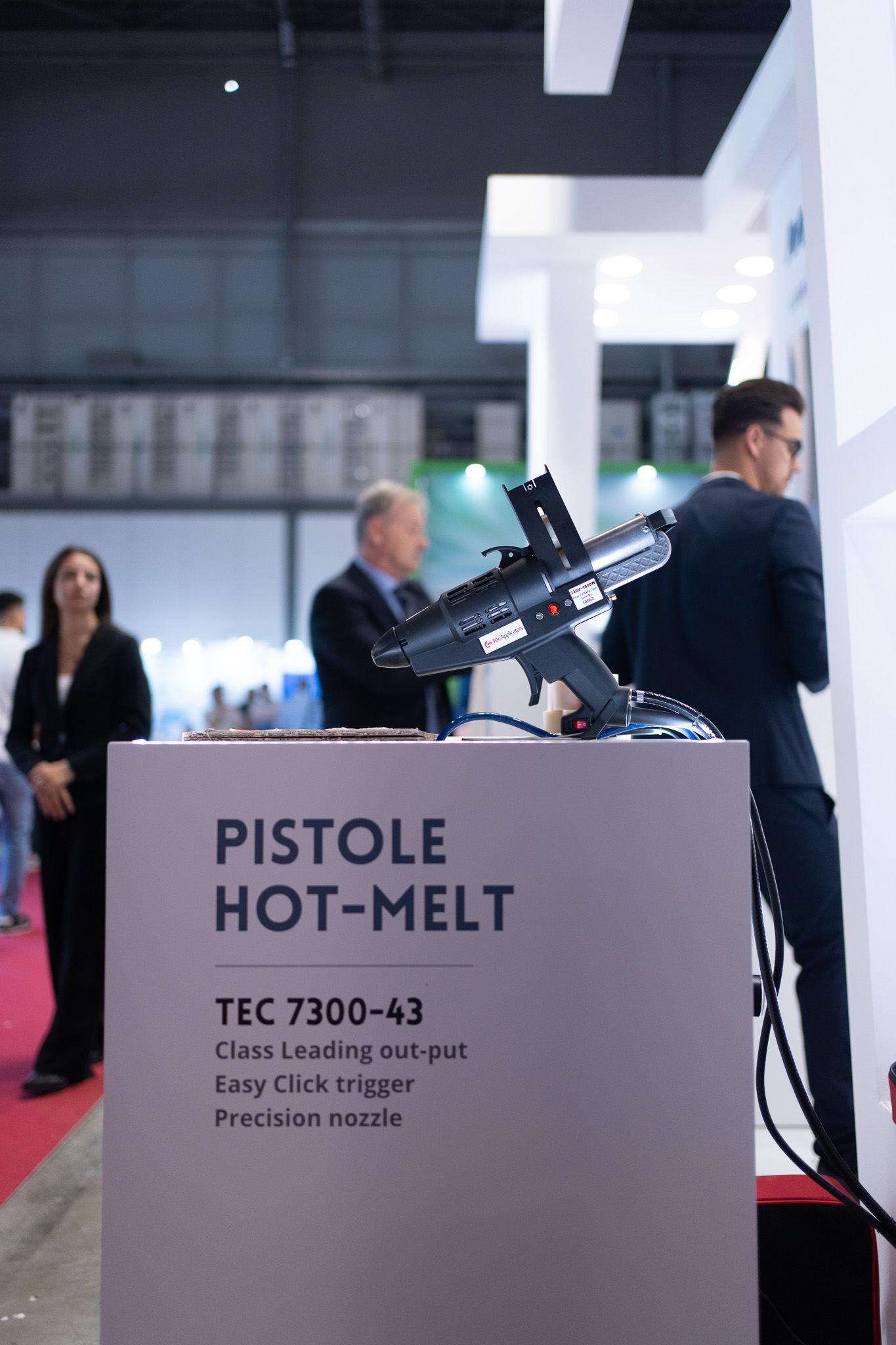
For more information about biodegradable hot melt adhesives and the Tecbond adhesive range, contact our Mascherpa experts or visit our Mascherpa Expert page dedicated to hot melt adhesives for packaging and labeling.
If you want to learn more about Hot Melt solutions for the food and packaging sector, watch the podcast made for the Ipack-IMA 2025 fair: