Key points of the composite material pultrusion process
- The pultrusion of composite materials is a continuous process based on pulling impregnated reinforcements through a heated die.
- The main stages include feeding of reinforcements, impregnation, forming, polymerization, and pulling.
- Viscosity, pot life, gel time, and glass transition temperature are central parameters in selecting resins for pultrusion.
- Glass fibers, carbon, and aramid can be configured as unidirectional fabrics, multiaxial, or tapes.
- Mascherpa offers ARALDITE® systems, SAERTEX® reinforcements, and Diatex peel ply tapes to be evaluated in relation to line characteristics.
The pultrusion is a continuous process in which fibers, fabrics , and other reinforcements are impregnated with a resin system, are pulled through a heated die e polymerize as they advance.
The outcome of the process depends on the balance between impregnation of reinforcements, viscosity, and reactivity of the resin, temperature of the die, and speed of the line. The selection of materials must therefore be made considering the behavior of the entire production system.
Mascherpa supports companies in selecting ARALDITE® epoxy systems, SAERTEX® reinforcement fabrics, and auxiliary materials for the pultrusion of composite materials.
Index
- What is pultrusion?
- How the pultrusion process works
- Which materials are used in pultrusion
- How to select a resin for pultrusion
- ARALDITE® resin systems for the pultrusion process
- SAERTEX® fabrics and tapes for pultrusion
- Line speed and polymerization control
- Why integrate the selection of resin and reinforcement
- Frequently asked questions about the pultrusion process
- Mascherpa support in composite pultrusion
What is pultrusion?
Pultrusion is a process used to produce continuously composite material components with constant cross-section.
The reinforcement materials are:
- fed from spools;
- impregnated with a resin system;
- pulled through a heated die.
Inside the die, the composite materials take on the intended geometry, and the resin polymerizes. The solidified material then continues to advance along the line and can be cut to the required length.
The production of tubes, bars, rods, and pultruded profiles represents the outcome of the process. From a production standpoint, however, the decisive step is the coordinated management of reinforcements, composite resin system, and polymerization conditions.
How the pultrusion process works
Pultrusion systems integrate continuous feeding of reinforcements, impregnation, a heated die, and a pulling system.
Each stage influences the next. Changing the type of fabric, the amount of fiber, the viscosity of the mixture, or the advance speed can alter the behavior of the composite throughout the line.
Feeding of reinforcements
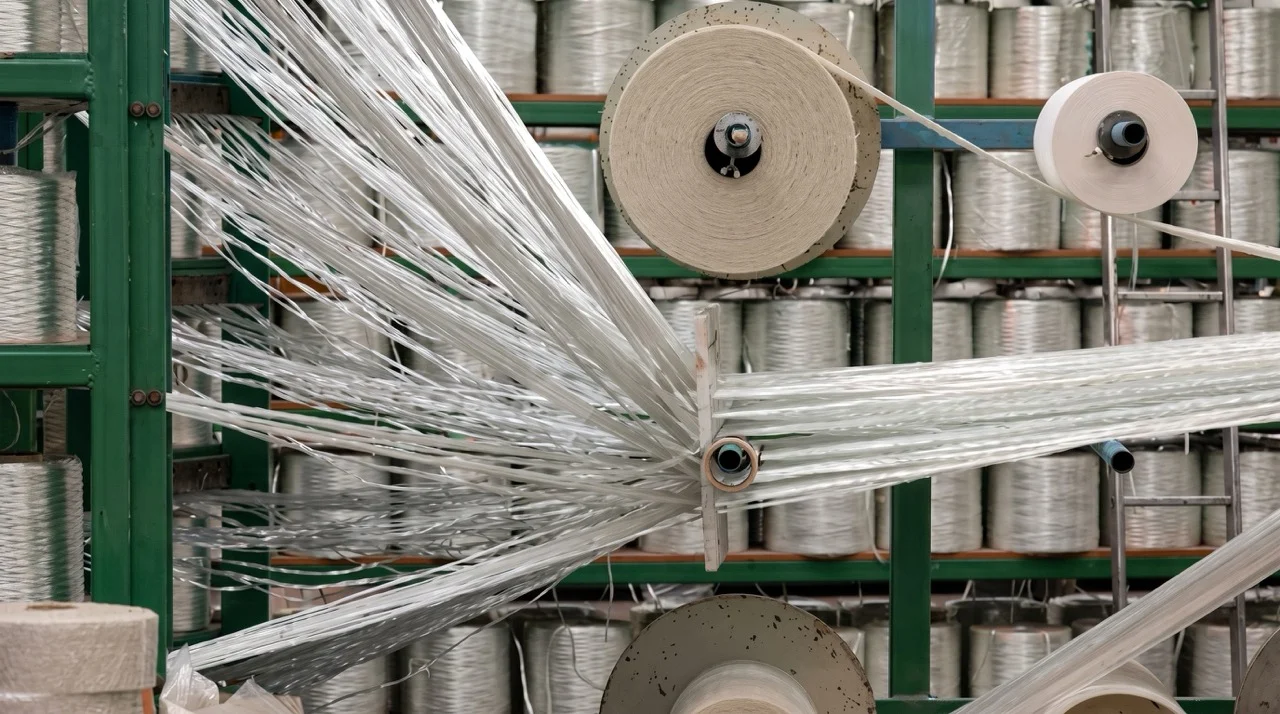
The process begins with the feeding of reinforcements, generally supplied on spools.
The following can be used:
- continuous fibers;
- tapes;
- unidirectional fabrics;
- multiaxial fabrics.
Fiber type, areal weight, and orientation must be defined in relation to the characteristics required of the component. A unidirectional reinforcement concentrates fibers along a primary direction. A multiaxial structure instead combines multiple orientations to respond to stresses coming from different directions.
Impregnation with the composite resin system
The reinforcements are then impregnated with the composite resin system.
The main configurations include:
- Open bath impregnation: the reinforcements pass through the resin bath before entering the die.
- Impregnation via injection chamber: impregnation occurs through a closed system integrated into the line.
In both cases, the mixture must penetrate properly between the fibers before polymerization. For this reason, the following are particularly important:
- viscosity;
- impregnation capability;
- pot life;
- reactivity;
- compatibility with the reinforcements.
Not only a base resin is selected, but a system composed of resin, hardener, and possibly an accelerator.
Forming and polymerization
Once impregnated, the reinforcements enter the heated die.
During passage:
- The materials are gathered into the intended configuration.
- The composite material takes on the cross-section of the die.
- The temperature activates the reaction of the epoxy system.
- The material transitions progressively from a liquid state to a solid one.
The reaction must begin and develop at the correct point in the die. Polymerization that is too early can interfere with impregnation and advancement. A Insufficient reaction can instead cause the material to exit the die without the necessary degree of conversion.
Continuous pulling
The polymerized material is pulled out of the die by a mechanical system.
The pulling speed must be coordinated with:
- reactivity of the resin system;
- temperature of the die;
- geometry of the component;
- quantity and configuration of reinforcements;
- time required for polymerization.
The continuity of the process allows production without opening and closing the mold after each component.
Which materials are used in pultrusion
Pultrusion primarily combines:
- A polymer matrix, obtained through the composite resin system.
- A fibrous reinforcement, consisting of fibers, tapes, or fabrics.
- Any auxiliary materials integrated into the production configuration.
For Mascherpa, the product families most directly connected to the process are:
- ARALDITE® epoxy systems;
- fabrics and tapes in glass fiber;
- fabrics and tapes in carbon fiber;
- SAERTEX® multiaxial and unidirectional fabrics;
- Diatex peel ply tapes.
Resin systems for pultrusion
The resin system impregnates the fibers and forms the matrix of the composite material after polymerization. For pultrusion, epoxy systems with amine hardeners or anhydride–based are available.
The different combinations allow intervention on:
- viscosity;
- pot life;
- reaction speed;
- glass transition temperature;
- polymerization conditions;
- production speed.
Systems with anhydride-based hardeners can combine long latency at room temperature with faster polymerization at die temperatures. This characteristic allows maintaining the system workable during impregnation and activating the reaction during passage through the heated die.

Glass fiber reinforcements
The Glass fiber pultrusion can use continuous fibers, unidirectional fabrics, multiaxial e tapes.
SAERTEX® reinforcements can be configured by varying:
- areal weight;
- fiber orientation;
- number of layers;
- overall architecture;
- material format.
The choice of fiberglass tapes must be linked to the direction of the loads, the geometry, and the ability of the resin system to impregnate the fibrous structure.
Carbon fiber reinforcements
Carbon fiber for pultrusion can be used in the form of continuous fibers, fabrics unidirectional, multiaxial, or tapes.
In this case as well, choosing the type of fiber is not enough. The following must be evaluated together:
- orientation;
- amount of reinforcement;
- areal weight;
- epoxy system;
- impregnation conditions;
- curing profile.
Carbon pultrusion therefore requires coordinated design between fiber, resin and line parameters.

Peel ply tapes
Available auxiliary materials for pultrusion also include Diatex peel ply tapes.
The continuous format allows them to be fed along the line together with the other materials required by the production configuration. The choice of peel ply fabric must consider:
- tape material;
- width;
- compatibility with the resin system;
- method of insertion into the line;
- specific application requirements.
Not all peel plies have the same characteristics. The product must therefore be evaluated together with the other materials in the process.

How to select a resin for pultrusion
The choice of pultrusion resins must start from the actual line conditions, not from a single value reported in the technical documentation.
Viscosity and impregnation
Viscosity influences the ability of the mixture of penetrate between the fibers. A low-viscosity system can promote impregnation, but it must be evaluated in relation to:
- amount of reinforcement;
- fabric structure;
- impregnation method;
- processing temperature;
- line speed.
Viscosity alone is therefore not sufficient to determine the suitability of the system.
Pot life
Pot life indicates how long the system remains workable under the defined conditions.
In pultrusion, it may be necessary to keep the mixture stable during feeding and impregnation, preventing the reaction from starting prematurely. High-latency systems are developed specifically to combine workability at room temperature and reaction at die temperatures.
Gel time and reactivity
Gel time helps to evaluate the speed with which the system loses its fluidity under test conditions.
Reactivity must be compatible with the line speed . Some systems also allow for the combination of different hardeners to regulate the behavior of the mixture and adapt it to the process.
Glass transition temperature
The glass transition temperature, or Tg, allows for the differentiation of systems intended for different thermal requirements.
Solutions are available with Tg:
- standard;
- medium-high;
- high;
- adjustable through system configuration and curing cycle.
The Tg value must be read together with viscosity, reactivity, curing conditions, and mechanical performance.
Line speed
The achievable speed depends on the interaction between:
- resin system;
- temperature;
- residence time in the die;
- geometry;
- thickness;
- reinforcements used.
Values obtained under test conditions are useful for comparing systems, but they must be verified on the actual production configuration.
ARALDITE® resin systems for the pultrusion process
The ARALDITE® range includes epoxy systems developed for different pultrusion conditions. The formulations are distinguished by viscosity, pot life, gel time, processing speed, glass transition temperature, and the characteristics required of the composite material.
The choice must start from the line conditions and the application objective. Systems are available for standard processes, high-speed production, high thermal requirements, water and chemical resistance, or flame-retardant properties.
| Epoxy system | Mixture viscosity at 25 °C | Pot life at 23 °C | Gel time at 180 °C | Pultrusion speed | Tg | Key Features |
| ARALDITE® LY 1561 / ARADUR® 1562-1 / ARADUR® 1562-2 | 800-1,100 mPa·s | >10 h | 25-35 s | 60-80 cm/min | 125-135 °C | Standard system for general industrial applications and the wind power sector |
| ARALDITE® LY 1561 / ARADUR® 1563 | 600-1,000 mPa·s | >10 h | 23-27 s | 20-40 cm/min | 115-125 °C | Very long pot life, color stability, and use on complex fiberglass components |
| ARALDITE® LY 1561 / ARADUR® 1562M | 800-1,100 mPa·s | >10 h | 20-25 s | 80-120 cm/min | 125-135 °C | System developed for high-speed pultrusion processes |
| ARALDITE® LY 1578 XD / ARADUR® 1578-1 XD | 800-1,000 mPa·s | >10 h | 24-27 s | 20-40 cm/min | 165-185 °C | Medium-high Tg system with wear, water, and chemical resistance |
| ARALDITE® CY 5192-1 / ARADUR® HY 5192-1 | 500-800 mPa·s | >10 h | 48-55 s | 40-60 cm/min | 210-230 °C | Low-viscosity system suitable for 9.5 mm composite cable cores |
| ARALDITE® CY 5192-1 / ARADUR® HY 5196-2 | 500-800 mPa·s | >10 h | 48-55 s | 40-50 cm/min | 220-230 °C | Low-viscosity system suitable for 9.5 to 11 mm composite cable cores |
| ARALDITE® CY 5196 / ARADUR® HY 5196 / ACCELERATOR DY 5196 | 450-550 mPa·s | >10 h | 47-51 s | 40-50 cm/min | 180-200 °C | System intended for large-sized composite cable cores |
| ARALDITE® LPY 21007A / ARADUR® LPY 21007B | 600-1,000 mPa·s | >10 h | 47-51 s | 21-23 cm/min | 110-125 °C | Pultrusion system with flame-retardant properties |
SAERTEX® fabrics and tapes for pultrusion
SAERTEX® develops unidirectional and multiaxial fabrics in fiberglass, carbon, and aramid, configurable for different composite material processes, including pultrusion.
The reinforcement structure can be defined based on:
- fiber type;
- areal weight;
- number of layers;
- orientation;
- load direction;
- resin system;
- production process.
Unidirectional fabrics
In unidirectional fabrics, the fibers are concentrated mainly along one direction. This configuration allows for the orientation the of reinforcement in the in the main direction of the of the load and for leveraging the properties of fibers along the axis intended by the design.
Multiaxial fabrics
Multiaxial fabrics combine layers with different orientations. Fiber type, quantity, and arrangement of layers can be adapted to the needs of the component and the process.
Line speed and polymerization control
Increasing the speed of a plant does not simply mean increasing the pulling force. During the passage through the die, the resin goes through different states:
- remains fluid during impregnation;
- reaches the gelation zone;
- progressively increases its degree of conversion;
- solidifies before exiting the die.
To define the parameters, the following must be considered:
- temperature of the die;
- temperature on the surface of the composite;
- temperature at the center;
- position of the gelation zone;
- degree of conversion;
- feed speed.
Pultrusion-specific simulation tools allow the curing profile to be related to the line speed, supporting system selection and the definition of process parameters.
Why integrate the selection of resin and reinforcement
A resin system may have adequate viscosity, Tg, and gel time values, but not be automatically suitable for every line.
Similarly, a fabric may offer the required orientation but have characteristics that modify the impregnation or the amount of resin required.
Selection must therefore jointly consider:
- impregnation method;
- reinforcement architecture;
- viscosity;
- pot life;
- reactivity;
- die temperature;
- pulling speed;
- required properties of the composite material.
It is this integration that makes the system consistent with the production process.
Frequently asked questions about the pultrusion process
Which resins are used in pultrusion?
Different systems can be used. Mascherpa offers ARALDITE® epoxy systems configured with hardeners and accelerators selected based on viscosity, reactivity, Tg, and production speed.
Which reinforcements can be used?
The process can use continuous fibers, unidirectional and multiaxial fabrics, and fiberglass, carbon, or aramid tapes.
How do you choose a resin for pultrusion?
The choice depends on impregnation method, viscosity, pot life, reactivity, die temperature, line speed, and the properties required in the composite.
Why is resin reactivity important in the pultrusion process?
The resin must remain workable during impregnation and cure properly inside the die. A reaction that is too early or too slow can interfere with the process.
Mascherpa support in composites pultrusion
Mascherpa supports companies in the selection of materials for the pultrusion process.
The solutions include:
- ARALDITE® epoxy systems;
- SAERTEX® unidirectional fabrics;
- SAERTEX® multiaxial fabrics;
- glass fiber tapes;
- carbon fiber tapes;
- peel ply.
The analysis starts from the line of the conditions and relates the impregnation system, reinforcements, , die, temperature, , and line e performance speed to the required properties.
In this way, the choice is not based on a single product or parameter, but on the compatibility between materials and the pultrusion process. Each line presents specific conditions.
Contact Mascherpa experts to evaluate ARALDITE® systems, SAERTEX® reinforcements, and auxiliary materials for your pultrusion process.