Key Points
- Surface treatment optimizes the substrate properties, allowing the adhesive to adhere uniformly and stably on different materials.
- Surface treatment differs from surface preparation, which involves the removal of contaminants before adhesive application.
- Each material requires specific treatment methods, such as abrasion, chemical etching, plasma, or flame treatments.
- Metals, plastics, composites, and industrial materials have different technical requirements that directly affect bonding quality.
- Proper surface treatment maximizes the performance of Araldite® adhesives.
Surface treatment is a fundamental step to achieve a reliable and durable bond. After the surface preparation, necessary to remove contaminants and residues, surface treatment allows for optimizing the properties of the surface so that the adhesive can bond correctly.
The appropriate surface treatment varies depending on the material and may include mechanical processes, chemical or physico-chemical treatments, detailed for metals, plastics, composites and other industrial materials.
Index
- Difference between surface treatment and surface preparation
- The importance of surface treatment
- The different treatable surfaces and their differences
- Surface treatment of metals
- Surface treatment of plastics and composites
- Surface treatment of other industrial materials
- Surface treatment and Araldite® adhesives: what changes in performance
- Dedicated technical support regarding surface treatment
Difference between surface treatment and surface preparation
Surface preparation is the first essential step for any bonding and involves the removal of contaminants such as oils, release agent residues or impurities. Some of the methods for surface preparation are: degreasing, abrasion, and chemical or physical treatments.
Surface treatment, on the other hand, is the subsequent phase and involves specific interventions aimed at modifying or activating the material’s surface, significantly improving its wettability and adhesion capacity.
Depending on the substrate, surface treatment may involve controlled abrasions, chemical etching, plasma treatments, or other targeted surface activation techniques.
The importance of surface treatment
Surface treatment is crucial for achieving high performance in bonding.
Without dedicated intervention, many surfaces would not offer the ideal conditions for proper adhesion. Treatment allows for:
- making the surface more active and receptive to the adhesive;
- removing inadequate layers or incompatible with bonding;
- creating controlled roughness favorable for anchoring; controllata favorevole all’ancoraggio;
- establishing an optimal condition so that the adhesive can bond in a uniform and stable manner.
Since each material reacts differently, it is essential to adopt the most suitable surface treatment for the type of surface, following specific procedures to achieve a reliable result.
The different treatable surfaces and their differences
Surface treatments vary based on the material to be bonded. Treatable surfaces include:
- metal and metal alloys;
- plastics and thermoplastic materials;
- composites and thermosets;
- various industrial materials (such as glass, ceramics, rubber, wood, carbon, stone, cement, and other technical materials).
Each of these categories requires specific methods, which may include abrasion, chemical processes or surface activations depending on the substrate characteristics.
Surface treatment of metals
Surface treatment methods for metals vary depending on the type of metal.
The wide range of individual alloys (and the variety of surface structures caused by heat treatments) within each group of metals prevents of standardizing a single pretreatment for each of them.
The following treatments are well established, but in some cases, a different pretreatment may prove more effective. This can only be demonstrated through comparative tests, using materials from the batch of metal components to be bonded and the type of adhesive specified for the job.
| Substrate | Preferred pretreatment (state of the art) | Alternative solution | Notes |
| Aluminum and non-anodized alloys | Degreasing + Special treatment | Abrasion | Special pretreatment: chromic or phosphoric acid anodization. |
| Aluminum and anodized / unsealed alloys | None | None | Chromic or phosphoric acid anodized material exhibits optimal surface properties for bonding immediately after the anodization process is completed. No surface treatment is necessary, but bonding must occur within a few hours of anodization. |
| Aluminum and hard anodized / anodized and sealed alloys | Degreasing + Special treatment | Abrasion | Special pretreatment: abrasive blasting or etching is required. Untreated metal is not suitable for bonding. Aluminum alloys anodized with standard chromic or sulfuric acid methods and sealed can be bonded after degreasing and light abrasion. |
| Cadmium | Degreasing + Special treatment | Abrasion | Special pretreatment: electrolytic plating with silver or nickel. |
| Cast iron | Degreasing + Abrasion | None | – |
| Copper and copper alloys | Degreasing + Special treatment | Abrasion | Special pretreatment: etching solution. |
| Chrome | Degreasing + Special treatment | Abrasion | Special pretreatment: etching solution. |
| Galvanized surfaces | None | None | – |
| Gold | Degreasing | None | – |
| Lead | Degreasing + Special treatment | Abrasion | Special pretreatment: etching solution. |
| Magnesium and magnesium alloys | Degreasing + Special treatment | Abrasion | Special pretreatment: etching solution. |
| Nickel and nickel alloys | Degreasing + Special treatment | Abrasion | Etch for 5 seconds in concentrated nitric acid. Rinse with clean cold running water, then with clean hot water and dry with hot air. |
| Silver | Degreasing + Abrasion | None | – |
| Mild steel | Degreasing + Special treatment | Abrasion | Special pretreatment: etching solution. |
| Stainless steel | Degreasing + Special treatment | Abrasion | Special pretreatment: etching solution. |
| Tin | Degreasing + Abrasion | None | – |
| Titanium and titanium alloys | Degreasing + Special treatment | Abrasion | Special pretreatment: etching solution. |
| Tungsten and tungsten carbide | Degreasing + Special treatment | Abrasion | Special pretreatment: etching solution. |
| Zinc and zinc alloys | Degreasing + Abrasion | None | Apply the adhesive immediately after surface preparation. |
Surface treatment of plastics and composites
The most common plastic and composite materials that can be bonded are listed in the table below. The type of surface treatment varies based on the material’s chemical structure and the presence of release agents, typical of molding processes.
Thermosets
Moldings, castings, laminates and similar can usually be bonded without difficulty.
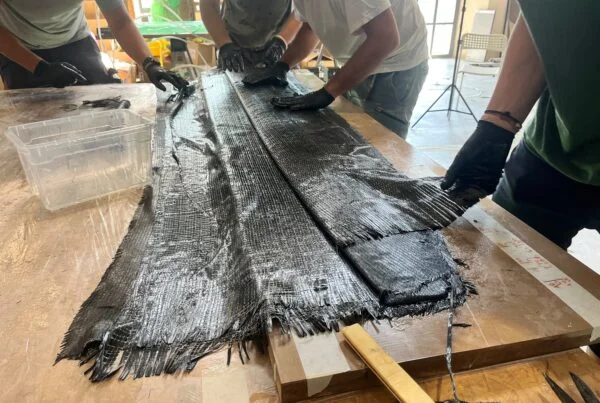
However, to ensure good adhesion strength, all surface contaminants (such as release agent residues) must be removed from the surfaces to be joined before adhesive application. Surfaces must undergo abrasion, or be cleaned with an organic solvent such as acetone, methyl ethyl ketone (MEK) or isopropanol.
Abrasion, sandblasting or peel ply are highly recommended for molded parts, as their surfaces might otherwise repel the adhesive.
Thermoplastics
Although thermoplastics are often difficult to bond, the wide range of industrial adhesives Huntsman offers a solution.
Surface treatments, such as plasma, flame, and corona discharge, are particularly effective for bonding thermoplastics.
Some types of thermoplastics, such as polyethylene and polypropylene, are particularly difficult to bond and produce limited bonding strength even after surface treatment.
| Substrate | Preferred Pretreatment (State of the Art) | Alternative Solution | Notes |
| ABS | Degreasing + Special Treatment | Abrasive | Special Pretreatment: etching solution or plasma treatment. |
| Cellulose-Based Polymers | Degreasing + Abrasion | None | Preferably heat for 1 hour at 100 °C and apply the adhesive before the material cools completely to room temperature. |
| Composites (fiber-reinforced thermosets) | Degreasing + Abrasion | Abrasion + Special Treatment | Alternatively, design the laminate so that a “peel ply layer” of tightly woven special fabric is placed on the bonding surface. The layer becomes part of the laminate during curing and is removed before bonding, exposing a clean, rough surface. Special Treatment: plasma treatment. |
| Decorative and Industrial Laminates | Degreasing + Special Treatment | Abrasive | Special Pretreatment: surface treatment by corona/plasma treatment. |
| Polyacetal (POM) | Degreasing + Special Treatment | None | Special Pretreatment: etching solution. |
| Polyamides (Nylon) | Degreasing + Special Treatment | Abrasive | Special Treatment: pretreatment by corona/plasma treatment. |
| Polyacrylics (PMMA…) | Degreasing + Abrasion | Abrasion + Special Treatment | For optimal results, it is recommended to subject the material to a stress-relieving treatment by annealing. Special Pretreatment: plasma treatment. |
| Polycarbonate | Degreasing + Special Treatment | Abrasive | Special Treatment: pretreatment by corona/plasma treatment. |
| Polyesters (unsaturated thermosets) | Degreasing + Abrasion | None | – |
| Polyesters – Thermoplastic Moldings and Films | Degreasing + Special Treatment | Abrasive | Special Pretreatment: etching solution. Alternative: corona/plasma treatment. |
| Polyetheretherketone (PEEK) | Degreasing + Special Treatment | Abrasive | Special Treatment: pretreatment by corona/plasma treatment. |
| Polyimide | Degreasing + Special Treatment | Abrasive | Special Treatment: pretreatment by corona/plasma treatment. |
| Polyolefins (PP, PE) | Degreasing + Abrasion | None | Special Pretreatment: surface treatment by flame/plasma. Lightly flame treat with a waving motion in an oxidizing flame until the surface becomes glossy. Specific primers for polypropylene are available as an alternative to flame and plasma treatments. |
| Polyphenylene Oxide (PPO) | Degreasing + Special Treatment | Abrasive | Special Treatment: pretreatment by corona/plasma treatment. |
| Polystyrene | Degreasing + Abrasion | None | – |
| Polyurethane | Degreasing + Special Treatment | Abrasive | Special Treatment: pretreatment by corona/plasma treatment. |
| PTFE and similar fluorocarbon plastics | Degreasing + Special Treatment | None | Fluorocarbon-based polymers normally cannot be bonded in the untreated state. However, specialized processes (involving flame oxidation or exposure to sodium metal dispersions) are available for treating fluorocarbon polymer surfaces. |
| PVC | Degreasing + Abrasion | None | – |
| SMC / BMC | None | None | – |
Surface treatment of other industrial materials
Most other common industrial materials that can be bonded are listed in the table below.
For non-metallic or non-plastic substrates, surface preparation may also be necessary to achieve optimal bonding. The following table provides solutions for mineral materials, rubbers, leather, and wood.
| Substrate | Preferred Pretreatment (State of the Art) | Alternative Solution | Notes |
| Bricks and Other Unglazed Fired Building Materials | Degreasing + Abrasion | None | Brush with a wire brush and remove dust. |
| Carbon | Degreasing + Abrasion | None | Abrasive with a cloth or fine sandpaper and remove dust. |
| Ceramics | Degreasing + Abrasion | None | Polish with a paste made of silicon carbide powder and water. |
| Concrete and Mortar | Degreasing + Abrasion | Abrasion + Special Treatment | Even when concrete is in good condition, it should be pretreated, where possible, with one of the following methods. 1) Remove by mechanical scarification 3 mm – or more – of all bonding surfaces, then remove dust preferably with a vacuum cleaner (more effective).
2) Sandblasting with removal of about 1.5 mm of all bonding surfaces, then remove dust preferably with a vacuum cleaner. 3) Special Treatment: etching solution. |
| Terracotta | Degreasing + Abrasion | None | – |
| Friction Materials (Brake Pads and Linings) | Degreasing + Abrasion | None | – |
| Glass | Degreasing + Special Treatment | Abrasive | Special Treatment: surface pretreatment with a silane-based primer enhances bonding performance. Alternatively, heat for half an hour at 100 °C and apply the adhesive before the glass cools completely to room temperature. |
| Graphite | Degreasing + Abrasion | None | Abrasive with fine sandpaper or cloth and remove dust. |
| Gemstones | Degreasing | None | – |
| Leather | Degreasing + Abrasion | None | Roughen with sandpaper and remove loose particles. |
| Paints (Cataphoresis/Powder Coating) | Degreasing + Abrasion | None | – |
| Plaster | Degreasing + Abrasion | None | Allow surfaces to dry completely. Sand with fine sandpaper or cloth and remove dust. |
| Rubber | Degreasing + Special Treatment | Abrasive | Special Pretreatment: etching solution. |
| Masonry | Abrasive | None | Allow surfaces to dry completely. Brush with a wire brush and remove dust. |
| Wood | Abrasive | None | Ensure the wood is dry. Plane or sand with sandpaper and remove dust. |
Surface Treatment and Araldite® Adhesives: What Changes in Performance
Proper surface treatment allows the surface to reach ideal conditions for adhesion, improving the adhesive anchorage and contributing to greater bond uniformity. Materials such as oxidized metals, low-energy plastics, or sealed surfaces require specific interventions for the adhesive to fully express its performance.
In some cases, the absence of treatment can completely prevent bonding, while properly executed treatment allows for maximizing the effectiveness of Araldite® adhesives.
Dedicated Technical Support for Surface Treatment
Choosing the correct surface treatment is essential to ensure reliable bonding, especially in the presence of complex materials or particular conditions.
To identify the most suitable method and assess compatibility with Araldite® adhesives, the Mascherpa experts are available to provide specific guidance and dedicated support in industrial applications.