Key Points of the Alba Refit
- Alba is being modified to participate in the 1001VelaCup Foil with a partially foiling configuration.
- The failure of the previous rudder led to a rethinking of the structural configuration of the component.
- For the new rudder, SAERTEX unidirectional carbon fiber is used, orientable according to the principal directions of stress.
- The ARALDITE® LY 5052 / ARADUR® 5052 system and DIATEX consumables support the production of composite components by infusion.
- H.B. Fuller’s Körapop 954 Marine meets the requirements for sealing inspection openings and bonding deck hardware.
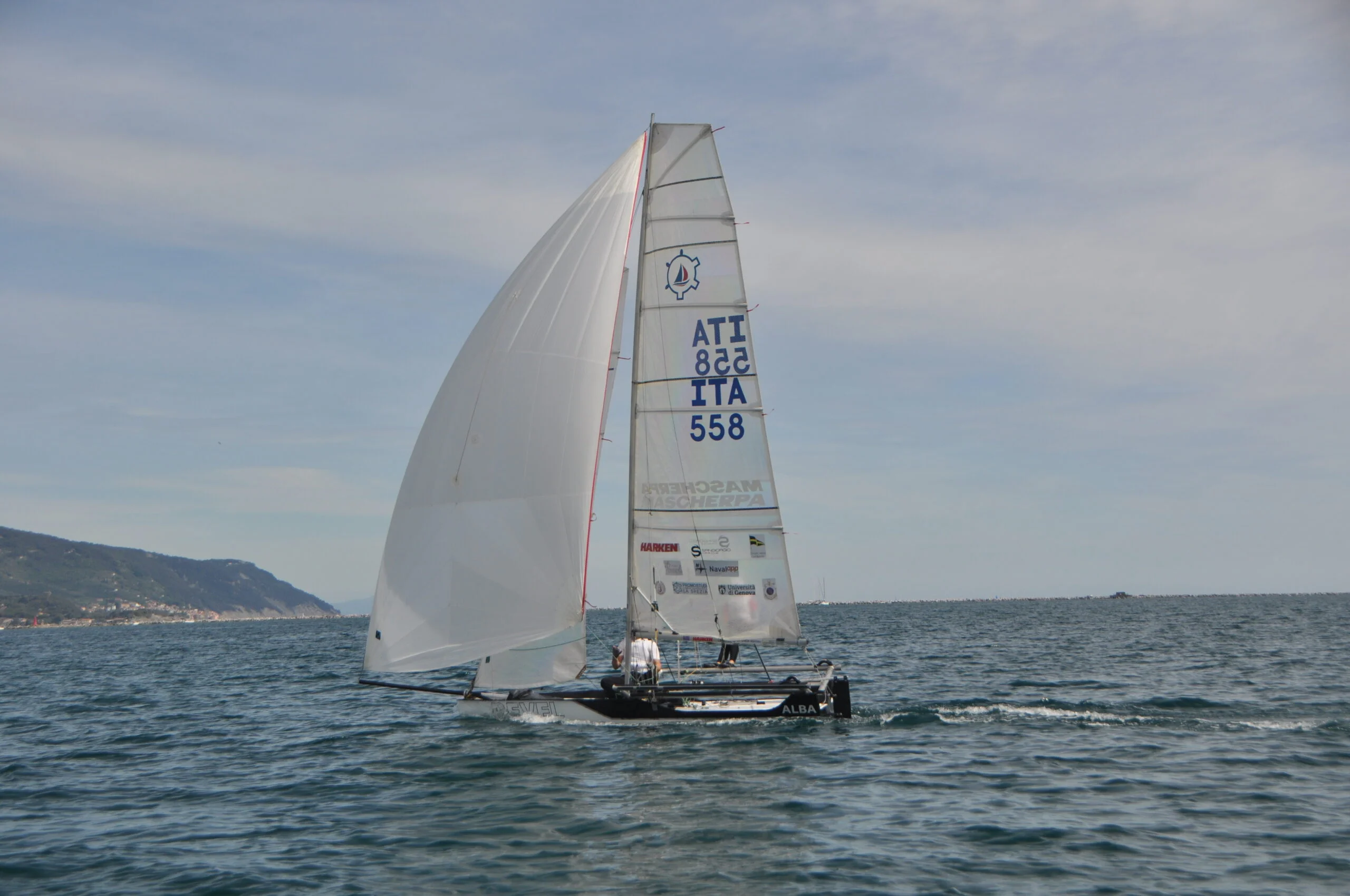
The skiff Alba has returned to the yard for a new phase of its evolution.
The first boat built by the Revel Sailing Team in 2024 is now undergoing a new refit with a precise objective: to transform it into a partially foiling boat through the development of a new system applied to the rudder, and to prepare it for the 1001VelaCup Foil.
This is not a project starting from scratch. The new refit builds on the experience accumulated with Alba over recent years, the problems encountered during sailing, and the solutions progressively developed by the team together with Mascherpa.

Alba, a Project Born to Evolve
The skiff Alba was born in 2024 as the first boat built by the Revel Sailing Team within the collaboration with Mascherpa.
It is an R3 class skiff, developed in compliance with the requirements of the 1001VelaCup. The competition regulations require that at least 75% of the materials used be composed of bio-based, recycled, or recyclable materials, and do not permit the use of carbon fiber for the construction of the hull.
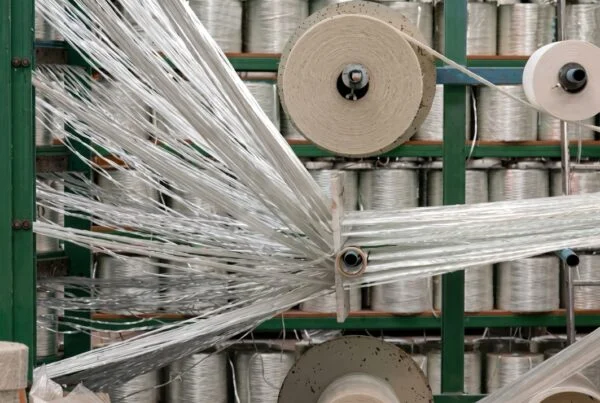
For this reason, in Alba’s original configuration, flax fiber and glass fiber were used primarily for the hull and structures, while carbon fiber was reserved for the appendages, where its use is permitted and allows exploitation of its high ratio of stiffness, strength, and weight.
The construction involved several technologies made available by Mascherpa: from fibers to resin systems, to materials for infusion and the structural core.
For the core material, 3D-CORE 10 mm was used, chosen also to facilitate a single-stage infusion process and achieve good adhesion between the core and the skins of the laminate.
The new refit, however, does not consist of rebuilding Alba. It builds precisely on this foundation and on the experience gained during its use to intervene at the points where the team has identified new margins for development.
From Rudder Failure to a New Solution
One of the most important steps in the evolution of Alba concerns the rudder. In the past, the component, made with a laminate of biaxial carbon fiber, suffered a failure. The incident provided the team with concrete data from which to restart in the design of the new appendage.
The failure is not attributed simply to the choice of the previous biaxial fabric. However, it led the designers to rethink how to distribute the material within the component and to seek a configuration that would allow more precise control of the reinforcement directions.
From this requirement comes the decision to move to a configuration based on unidirectional carbon fiber.
The new rudder also assumes an even more important role in the 2026 project: the foil that will enable Alba to compete in the dedicated category of the 1001VelaCup is integrated onto it. Alba therefore does not become a fully foiling boat. The refit introduces a partially foiling configuration, developed by modifying one of its appendages.
The New Unidirectional Carbon Fiber Rudder
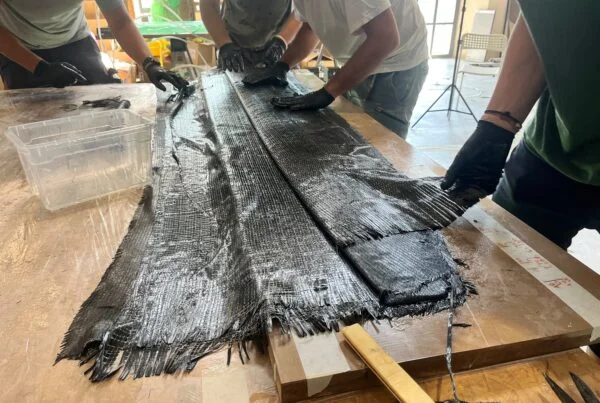
For the new rudder, the Revel Sailing Team chose a unidirectional carbon fiber from SAERTEX.
Unlike a biaxial fabric, the unidirectional configuration allows concentrating the fibers along a specific direction. For the designers, this means being able to place the reinforcement in the zones actually subjected to the greatest stresses and orient it according to the principal direction of the loads.
This provides greater freedom in the design of the laminate.
The material can be distributed where it is actually needed, avoiding adding reinforcement indiscriminately to the entire component. The objective is to improve the structural behavior of the rudder while keeping weight under control, a critical parameter on a racing boat.
The choice of carbon also remains consistent with the regulations of the 1001VelaCup: its use is not permitted for the hull, but is allowed on the appendages.
The transition from the previous biaxial laminate to a unidirectional configuration therefore represents one of the most concrete examples of the approach followed in the Alba refit: starting from what happened during sailing, analyzing the requirement, and modifying the design accordingly.

Resin and Infusion Process for the Alba Refit
The fiber must be matched with a resin system suited to the production process.
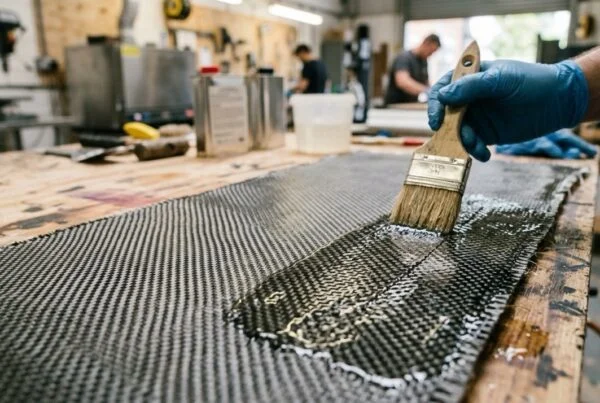
In the Alba project, the epoxy system ARALDITE® LY 5052 / ARADUR® 5052 from Huntsman is used, already part of the solutions employed by the Revel Sailing Team.
The system exhibits low viscosity and is suitable for the production of components in composite material. The solution used in the project also meets the competition requirements regarding the use of bio-based materials, thanks to the presence of raw materials derived in part from biomass.
Production takes place through an infusion process, for which Mascherpa also provides the consumables from DIATEX required for the various operational stages:
- Vacuum bag;
- vacuum tubing;
- distribution mesh;
- valves;
- channels for resin flow;
- INFUTAC.
The latter is used to keep the fibers correctly positioned during preparation.
On the new rudder of Alba, however, not 3D CORE core material is used: for this application, the focus is on the combination of
- carbon reinforcement;
- resin system;
- infusion process.
This is an important distinction because it shows how the selection of materials does not follow a fixed scheme. Each component requires identifying only the technologies actually necessary for the function it must perform.
H.B. Fuller for Sealing and Deck Outfitting
The refit did not concern only the new rudder.
During the work on Alba, the need also emerged to identify a solution for two operations related to the boat’s outfitting:
- The sealing of inspection openings, necessary to access the interior of the boat.
- The bonding of deck hardware, such as components that must be fixed to the boat’s surface.
In these applications, the requirements differ from those of a structural bonding of the laminate. The solution must withstand the conditions typical of the marine environment and external exposure, but must also allow rapid intervention on the boat when maintenance or repair operations are necessary.
For these requirements, Körapop 954 Marine from H.B. Fuller was chosen.
Körapop 954 Marine is a one-component elastic adhesive and sealant based on silane-modified polymer, developed also for applications in the marine sector.
Among the characteristics relevant to Alba are rapid polymerization, high stability to UV rays, and resistance to moisture and weathering. The product also meets the requirements of the International Maritime Organization (IMO).
These characteristics allow using a single solution for operations in which bonding and sealing must coexist, such as in the attachment of hardware of deck and in the closure of the openings used for inspection of the hull interior.
The choice of Körapop 954 Marine therefore arises from a precise application requirement: to be able to perform reliable interventions on the boat while reducing the time required to restore seals and components during preparation and maintenance phases.

Mascherpa’s Role in the Revel Sailing Team’s Journey
The Alba refit also illustrates the meaning of the collaboration between Mascherpa and the Revel Sailing Team within the NEXT project.
Mascherpa’s contribution does not simply consist of making a range of products available. Behind each material used is a need to be solved:
- better orienting the reinforcements in the new rudder,
- identifying a resin compatible with the process and with the competition constraints,
- correctly managing the infusion,
- finding a product capable of rapidly bonding and sealing elements exposed to the marine environment.
It is on these requirements that the dialogue between the university team and the Mascherpa technicians makes it possible to transform a catalog of materials into application solutions.
SAERTEX fibers, Huntsman Araldite systems, DIATEX consumables, and H.B. Fuller adhesives and sealants enter the project with different functions, selected based on the component, the production process, and the conditions of use.
Alba thus also becomes a proving ground in which experience on the water, design, and knowledge of materials continue to feed one another.
Alba Toward the 1001VelaCup Foil
The new chapter of Alba will take the boat to the 1001VelaCup Foil, scheduled for September in La Spezia.
Two years after its initial construction, Alba is not being replaced, but continues to evolve.
The new rudder, the transition to unidirectional carbon fiber, and the modifications to the outfitting represent the result of the experience accumulated by the Revel Sailing Team and the determination to transform every challenge encountered into a new design element.
This is also the logic underlying the collaboration with Mascherpa: starting from the application and the technical problem to identify materials, processes, and solutions capable of supporting the boat’s evolution.
To learn about the NEXT project and Mascherpa’s solutions dedicated to composite materials and marine applications, contact our experts.