Key points on the stainless steel blackening treatment
- Stainless steel blackening is a surface treatment that gives the metal a dark coloration.
- PRESTO BLACK® SSB allows for the cold treatment of most stainless steel alloys.
- The product can be applied by brush or immersion, including for manual touch-ups.
- Cleaning, rinsing, and sealing contribute to the quality of the finish.
- Applications managed by Mascherpa also include elements for kitchens and matte black shower profiles.
The blackening of stainless steel allows for a dark finish on mechanical components, decorative elements, and architectural details. The treatment is also applied in interior design, where the surface appearance contributes to the project’s outcome.
PRESTO BLACK® SSB is a solution for the cold blackening of stainless steel, usable by brush or immersion. Alongside industrial uses, Mascherpa has overseen its application on kitchen worktops and parts for kitchens, as well as on shower profiles with a matte black finish.

Index
- What is the stainless steel blackening process
- Cold vs. hot blackening: what are the differences
- PRESTO BLACK® SSB for stainless steel blackening
- How the cold blackening treatment is performed
- Stainless steel blackening in interior design: two Mascherpa applications
- How to evaluate the blackening result
- FAQ on stainless steel blackening
- From industrial finishing to interior design applications
What is the stainless steel blackening process
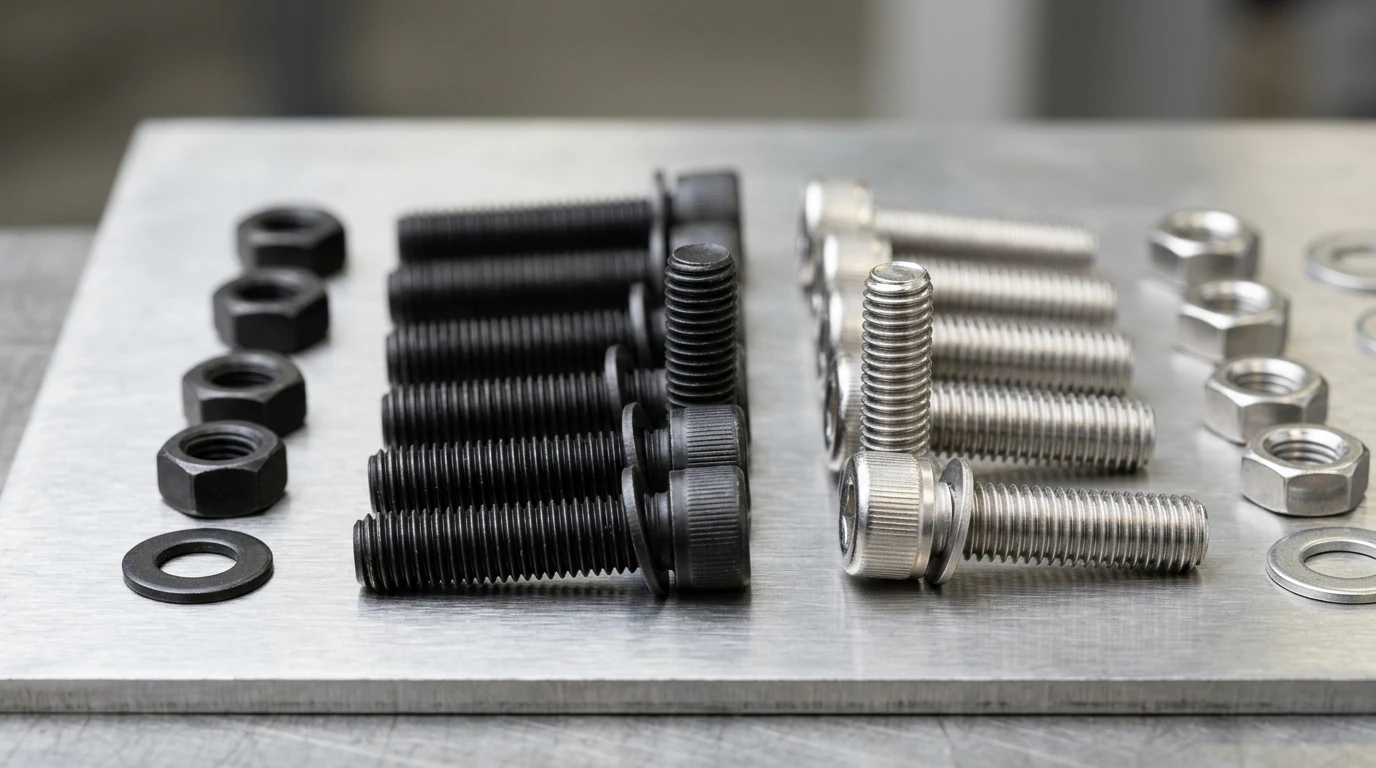
The blackening of stainless steel is a chemical surface treatment used to give stainless steel a dark coloration. It is used to modify the appearance of machined parts, fasteners, and decorative surfaces.
In the case of PRESTO BLACK® SSB, the blackening occurs at room temperature using a specific solution for stainless steel. The finish can be integrated into the production cycle or applied locally for touch-up requirements.
The blackening of metals includes treatments intended for different materials. For metal blackening, the choice of product must therefore start from the substrate: iron, carbon steel, and stainless steel require appropriate solutions. A liquid used for cold iron blackening should not automatically be considered suitable for stainless steel.
Cold vs. hot blackening: what are the differences
The difference primarily concerns the treatment temperature. Cold blackening is performed at room temperature, while hot processes require heated baths and specific cycles.
Both possibilities exist for stainless steel. PRESTO BLACK® SSB belongs to the cold solutions and can be applied by brush or immersion. The cycle must be chosen based on the material and the required result, without transferring parameters intended for other steels to stainless steel.
PRESTO BLACK® SSB for stainless steel blackening
PRESTO BLACK® SSB is the product in the PRESTO BLACK® range dedicated to the cold blackening of stainless steel and is effective on most stainless steel alloys and substrates.
The product is used in production finishing, in manual touch-ups and in the processing of decorative or architectural metal elements. Indicated applications include:
How the cold blackening treatment is performed
The cycle includes:
- the preparation of the surface,
- the application of the blackening agent,
- the rinsing,
- the protective finish.
Initial cleaning is crucial for achieving a uniform result.
Surface preparation and cleaning
Oil and surface residues must be removed before treatment. There are heavy-duty cleaners intended for cleaning mechanical parts.
Their formulation contains biodegradable surfactants and removes oil and residues from metal surfaces, preparing them for subsequent blackening.
Brush application
Brush application allows for local treatment of the surface and is also suitable for manual touch-up needs. For this method, PRESTO BLACK® SSB has a rapid reaction within the 1-3 minute range, forming a black finish without modifying the tolerances of the part.
The actual time must however be defined according to the product instructions and verified on the component to be treated.
Immersion application
For batch processing, the process can be organized using containers dedicated to cleaning, rinsing, and blackening, completing the cycle with a finishing sealer.
Rinsing and final protection
Rinsing and sealing complete the treatment. The protective finish contributes to the long-term protection of the part; the PRESTO BLACK® range also includes sealing and protective products.
To set up the cycle, it is necessary to refer to the operating instructions and the safety data sheet of the product actually used.
Stainless steel blackening in interior design: two Mascherpa applications
The possibility of giving a dark finish to stainless steel extends the uses of the treatment to furnishing elements and architectural components. Two applications overseen by Mascherpa involve kitchens and shower profiles.
Stainless steel worktops and parts for kitchens
The blackening of stainless steel is also applied in the creation of worktops and parts for kitchens, where the surface treatment contributes to the aesthetic characterization of the metal.
In this field, PRESTO BLACK® SSB was used to give a dark finish to stainless steel surfaces. The treatment thus includes blackening among the finishing possibilities for metal elements intended for interior design, extending its use beyond traditional mechanical components.
Shower profiles with matte black finish
Another application involves stainless steel shower profiles intended for a prestigious hotel structure in Tuscany. In this case, PRESTO BLACK® SSB was used to obtain a matte black finish, intervening on the appearance of the visible metal elements.
The purpose of the treatment was to give the profiles the coloration required for the interior design project.
The resulting finish received positive feedback, demonstrating an application of cold blackening even in components intended for the bathroom environment.
How to evaluate the blackening result
To evaluate stainless steel blackening, one must consider the alloy, the initial state of the surface, and the desired finish. The uniformity of the coloration also depends on the preparation of the component and the correct execution of the treatment.
With PRESTO BLACK® SSB, preliminary cleaning and subsequent rinsing are part of the cycle, which is completed with a finishing sealer to contribute to surface protection. The result should therefore be evaluated considering the entire treatment and the conditions of use of the part.
In furnishing elements, sampling of the actual material allows for verifying the tone and appearance of the surface before proceeding with processing.
FAQ on stainless steel blackening
Can stainless steel be cold blackened?
Yes, stainless steel can be blackened at room temperature using a solution formulated for this material. The treatment can be performed by brush or immersion, according to the methods specified for the chosen product.
Which liquid should be chosen for cold blackening of stainless steel?
It is necessary to use a blackening agent specific for stainless steel, verifying its compatibility with the alloy and the application method. A product intended for the blackening of iron or carbon steel is not automatically suitable for stainless steel. PRESTO BLACK® SSB is one of the solutions dedicated to this use.
How to prepare stainless steel before blackening?
The surface must be clean and free of oils, residues, and contaminations that can hinder the treatment. Preparation must follow the instructions of the chosen blackening agent: incomplete cleaning can compromise the uniformity of the coloration.
Does blackening modify the tolerances of the component?
With PRESTO BLACK® SSB, brush application produces a black finish without modifying the tolerances of the part. For precision components, the eventual final protection must also be considered, verifying that the complete cycle respects the dimensional requirements.
Does blackening protect stainless steel from corrosion?
Blackening does not make the component immune to corrosion. Protection depends on the alloy, the complete treatment, and the conditions of use. The protective product applied after blackening contributes to surface protection and must be chosen based on the application.
Is the blackened finish scratch-resistant?
A blackened finish should not automatically be considered scratch-resistant. Resistance depends on the treatment and the final protection. In components subject to frequent rubbing or handling, the behavior of the finish under the intended conditions of use must be verified.
Is a matte black finish always obtained?
No, matte black is not an automatic result of blackening. The final appearance depends on the material, the surface preparation, and the applied cycle, including the protective finish. Sampling allows for verifying the result on the actual component.
Can all stainless steel alloys be blackened?
Compatibility must be verified for the specific alloy and the product used. Even for steels such as AISI 304 and 316, it is advisable to check the technical indications and perform a test on the actual material before extending the treatment to production.
From industrial finishing to interior design applications
The cold blackening of stainless steel is used in the finishing of machined components, in touch-ups, and in the creation of decorative and architectural elements. Applications on kitchen worktops and shower profiles show how PRESTO BLACK® SSB can also be used when surface coloration is an integral part of the project.
The choice of cycle starts from the material and the required result. For more information on the PRESTO BLACK® SSB product and on metal blackening products, contact the Mascherpa experts or visit the PRESTO BLACK® page.