Key points on lubricants for ovens in the food industry
- High temperatures in food ovens can cause lubricant degradation, deposits, drips, and wear.
- The choice of lubricant depends on the actual temperature, load, and conditions of each component.
- Four applications show the solutions for chains, bearings, fans, and heat transfer circuits.
- NSF H1 and HT1 registrations must be combined with adequate performance and proper lubrication management.
- Automatic lubrication and scheduled maintenance help manage the quantity and frequency of interventions.
In ovens used for producing bread, biscuits, wafers, and other baked goods, maintenance and lubrication must contend with high temperatures and prolonged work cycles. Chains, bearings, and handling components must continue to operate without the lubricant degrading quickly, forming deposits, or dripping onto the product being baked.
Maintenance needs vary from one point of the machine to another. A chain requires an oil capable of maintaining lubrication at operating temperatures; a bearing needs a grease with characteristics suited to temperature, load, and speed.
Choosing lubricants for ovens in the food industry therefore means starting from the component and its operating conditions, combining technical performance with food safety requirements.
Four applications show how this approach translates into the choice of Mascherpa solutions.

Index
- Why maintenance and lubrication are critical in food ovens
- How to choose the lubricant for each point of the oven
- Four applications in food industry ovens
- When to consider automatic lubrication
- From product selection to oven maintenance
- Frequently asked questions about lubricants for ovens in the food industry
- Mascherpa at Cibus Tec 2026
Why maintenance and lubrication are critical in food ovens
A lubricant that degrades quickly can make frequent relubrication necessary, increase product consumption, and leave residues on components. On oven chains, the formation of carbon deposits and smoke emissions can require repeated cleaning and lead to progressive wear.
In bearings, on the other hand, the problem can manifest through the breakdown of the grease or the loss of consistency. If the lubricant leaves the point of application, protection of the component becomes less reliable, and drips may occur toward the production area.
Added to these mechanical issues is the possibility of accidental contact with food. The choice of food-grade lubricants must therefore be paired with controlled management of the application points, quantities, and maintenance intervals.
How to choose the lubricant for each point of the oven
The temperature of the baking chamber alone is not enough to identify the right product. It is necessary to know the conditions of the component to be lubricated: an external support, a bearing near the hot zone, and a chain passing through the oven may require different solutions.
The choice must take into account:
- the actual operating temperature,
- the load,
- the speed,
- the duration of the cycles,
- the accessibility of the point during maintenance.
The tendency to form residues and the ability to keep the lubricant in the intended area are also decisive factors.
For this reason, a chain oil and a bearing grease are not interchangeable solutions. Similarly, the heat transfer fluid in the heating circuit performs a different function: it transfers heat through the circuit.
In terms of food safety, the NSF H1 registration identifies lubricants intended for use where accidental contact with food may occur. For heat transfer fluids, the relevant reference is NSF HT1. These registrations must be considered together with the performance required by the application and the correct conditions of use.
Four applications in food industry ovens
From chain movement to heat transfer, each application presents specific critical issues. The following four cases show how the choice of oils, greases, and heat transfer fluids addresses different problems, while keeping the focus on the oven’s operating conditions.
Lubrication of baking oven chains with Tecnite OCL H1
On chains operating at high temperatures, maintaining effective lubrication without accumulating residues is one of the main requirements. When the oil degrades quickly, cleaning needs increase and consumption can become harder to control.
In an application at a bakery products manufacturer, carbon deposits and smoke emissions were forming on the baking oven chains. Oil consumption was high, cleaning was frequent, and the chains showed progressive elongation.
Tecnite OCL H1 was adopted, a high-temperature chain oil based on polyol esters, NSF H1 registered. The formulation has low evaporation and, for the application described, a heat resistance rated above 260 °C.
After the product was introduced, deposits and smoke were reduced, oil consumption decreased, and the service life of the chains was extended.
The case highlights how much high-temperature behavior and the tendency to leave residues matter when choosing an oven chain oil. The thermal reference should still always be verified against the actual conditions of the lubrication point.
Lubrication of bearings in tunnel ovens with Krytox™ greases
In tunnel ovens and ovens for wafers, prolonged exposure to heat can make the service life of some conventional greases insufficient. The problem affects both the protection of the bearing and the frequency of the interventions required to keep it lubricated.
A manufacturer of bakery and wafer products was experiencing rapid breakdown of the greases used on the bearings, with carbonization and frequent replacements during continuous cycles.
The solution adopted was Krytox™ Corrugator 226 FG, a food-grade grease based on perfluoropolyether, or PFPE, characterized by chemical inertness and resistance to carbonization under the intended operating conditions.
In the application described, the bearings maintained lubrication for longer, making it possible to extend the service intervals.
PFPE fluorinated lubricants therefore represent a technology worth considering at thermally critical points where conventional greases degrade quickly. The selection must always be based on the bearing’s conditions and the product’s specifications.
Lubrication of rollers and fans with MOLYKOTE® greases
Rollers on the belt, carriages, and fans can have different requirements even within the same oven. Using the same grease on all points without checking their conditions can compromise the stability of lubrication.
In an industrial bakery plant, the grease used on the bearings was losing consistency during operation, to the point of dripping onto the products being baked.
MOLYKOTE® G-1502 FM Synthetic Bearing & Gear Grease was adopted at points compatible with its operating conditions, and MOLYKOTE® HP-300 at points exposed to higher temperatures, both NSF H1 registered.
The distinction between the two products is significant. MOLYKOTE® G-1502 FM has an upper operating limit of +150 °C and must be selected based on the actual temperature of the bearing.
MOLYKOTE® HP-300, PFPE-based with a PTFE thickener, offers high thermal stability and low vapor pressure of the base oil for points exposed to higher temperatures.
The use of the two greases at different points made it possible to keep lubrication stable, resolve the drip problem, and make maintenance interventions more predictable.
For fan bearings, the choice must therefore be based on the temperature of the individual support, which may differ from that of the baking chamber.
Heat transfer in tunnel ovens with PURITY™ FG fluids
In tunnel ovens equipped with heat transfer fluid heating, process continuity also depends on the conditions of the heat transfer circuit.
A biscuit manufacturer was experiencing rapid degradation of the fluid, with carbon deposits in the heat exchangers, loss of thermal efficiency, and frequent replacements.
PURITY™ FG Heat Transfer Fluid was adopted, a food-grade heat transfer fluid registered NSF HT1, with high thermal and oxidative stability.
In the application in question, the circuit maintained exchange efficiency for longer, and the downtime required for cleaning the heat exchangers was reduced.
The HT1 registration applies to heat transfer fluids used where accidental contact with food is possible. However, it does not make a potential leak negligible and does not automatically guarantee the compliance of the product involved, which must be handled according to the facility’s food safety procedures.
When to consider automatic lubrication
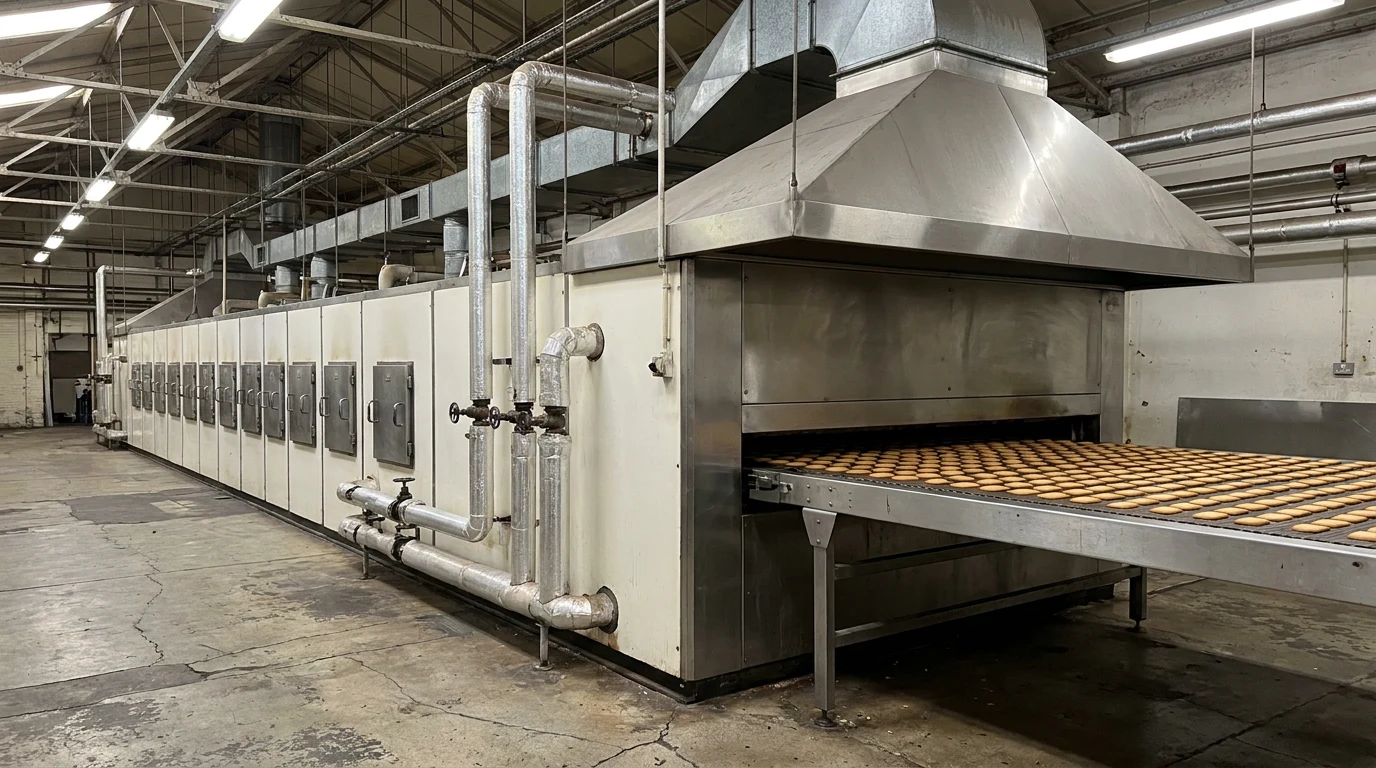
When the oven’s lubrication points are hard to reach or require frequent interventions, it may be worth considering automatic lubrication.
MEMOLUB systems allow the quantity and frequency of delivery to be programmed. However, their suitability must be verified together with the lubricant, taking into account:
- operating conditions,
- distance from the point,
- pressure,
- required frequency.
In the case of an oven, automation therefore requires a specific application assessment. The presence of a food-grade or high-temperature grease alone does not prove its compatibility with any given distribution system.
The goal is to make the supply of lubricant more consistent at points that can genuinely benefit from programmed delivery.
From product selection to oven maintenance
The four applications show why selection must start from the observed problem. Deposits on chains, grease breakdown, drips, and heat transfer fluid degradation involve different technologies and intervention methods.
Product selection must translate into a program that defines: where to apply it, in what quantity, and at what frequency, monitoring consumption, residues, and component conditions over time.
To learn more about the management of lubrication points and Mascherpa solutions for maintenance operations in food processing plants, visit our dedicated section or download the technical guide.
Frequently asked questions about lubricants for ovens in the food industry
Which lubricants are needed in food industry ovens?
It depends on the components and configuration of the oven. Chains may require specific high-temperature oils, while bearings, rollers, and fans require greases selected based on operating conditions. Ovens with a heat transfer circuit also require a heat transfer fluid.
How to choose an oil for oven chains?
The actual temperature of the chain, working conditions, evaporation, and tendency to form residues must be assessed. In the case described, Tecnite OCL H1 was adopted to address carbon deposits, smoke, and high oil consumption.
Is an NSF H1 lubricant always suitable for high temperatures?
No. The NSF H1 registration concerns use where accidental contact with food is possible; it does not identify a heat resistance class. The thermal limit and performance must be verified for each product.
Why do deposits form on oven chains?
Carbon deposits can result from oil degradation at operating temperatures. When choosing a lubricant, it is therefore necessary to assess thermal stability, evaporation, and the tendency to leave residues, along with application quantities and frequencies.
Does a food-grade lubricant eliminate the risk of contamination?
No. Suitability for accidental contact does not authorize intentional contact with food and does not replace control of leaks, drips, and quantities applied. Safety also depends on proper lubrication management and the facility’s procedures.
How often should food oven components be lubricated?
There is no single frequency suitable for all components. Intervals depend on the lubricant, the operating conditions, and the characteristics of the point. They must be defined for the specific application and verified over time, by monitoring consumption, residues, and the condition of the components.
Mascherpa at Cibus Tec 2026
From October 27 to 30, 2026, Mascherpa will be at Cibus Tec, at Pavilion 02, Stand F061.
The trade fair will be an opportunity to discuss applications in food ovens with our technical team, and more broadly, the whole field of lubrication and maintenance for food processing plants.
For more information, contact us or request your ticket and come visit us at the fair.