Key Points
- Sport accelerates the development of composite materials, validating them under extreme conditions.
- Performance and design depend on lightness, strength, flexibility and durability.
- Sports projects become technological showcases for advanced industrial applications.
- Structural bonding and automation improve efficiency, integration and performance.
- The cases presented at JEC World show real-world applications of adhesives and composite processes.
When high-level sport stimulates innovation in composite materials, the impact goes far beyond competition. The global projects presented at JEC World 2026 demonstrate how advanced composite materials, structural bonding and bio-based materials are tested in preventing before being transferred to sectors such as automotive, energy or aerospace.
Sport thus becomes a true technological laboratory, where performance, structural design and sustainability evolve at maximum speed.

Index
- Factors influencing the performance of sports equipment
- Composite materials for sports: from competition to global innovation
- Sports projects as technological showcases
- Zeus Project: carbon composite trimaran
- Structural innovation in high-performance gear
- CompoTech PLUS and innovation in bicycle components
- Sustainable design without compromising performance
- Bcomp and natural fibers
- Huntsman ARALDITE® solutions for sports composite materials
- Mascherpa projects and solutions in composite materials for sports
- Dedicated solutions for Cober poles and rackets
- Composite lamination for Blossom skis
- JEC World 2026: the technological bridge for composite materials
- Looking to the future of composite materials
Factors influencing the performance of sports equipment
The key factors influencing the performance of today’s sports equipment are:
- lightness:
- strength;
- flexibility;
- fatigue resistance;
- ease of design.
Composite materials for sports: from competition to global innovation
The history of sport is inextricably linked to composite materials, from the first carbon fibers in Formula 1 to modern bio-based surfboards. Sport demands the extreme: lightness without sacrificing stiffness, fatigue resistance and, increasingly, circularity.
Unlike the automotive or aerospace sectors, sport allows for much faster development cycles. The urgency of win races or to reduce the weight of a bicycle by a few grams creates an environment where new technologies are validated in record time under maximum pressure.
Sport acts as a laboratory in the real world where durability and impact tests are not just simulated, but experienced.
Sports projects as technological showcases
Beyond competition, major sports projects serve as a “proof of concept” for emerging technologies. Media exposure accelerates the acceptance of these new materials and encourages cross-sector collaboration.
Whether it is a boat, a helmet or even a stadium, these projects demonstrate the real-time mechanical effectiveness and environmental impact of composite materials for sports.
Zeus Project: carbon composite trimaran
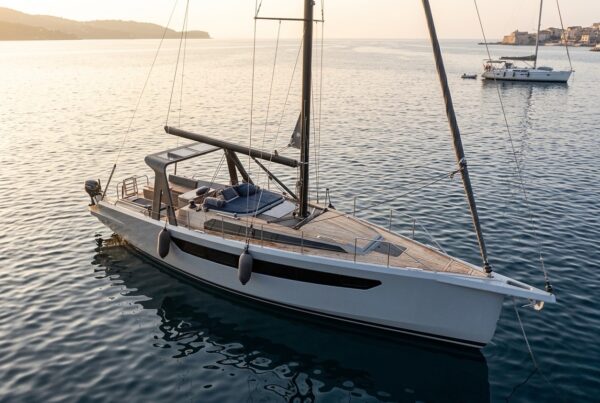
The Zeus Project (Paris 2024) is a prominent example of the application of composite materials for sports. Zeus is an electric trimaran built in carbon composite for the Paris 2024 Olympic Games.
Its design required advanced CAE simulations and precise anisotropic modeling. The innovation was optimizing load distribution, using extensive structural bonding instead of metal fasteners.
Zeus is a global demonstrator for sustainable naval mobility and offshore energy structures.
Structural innovation in high-performance gear
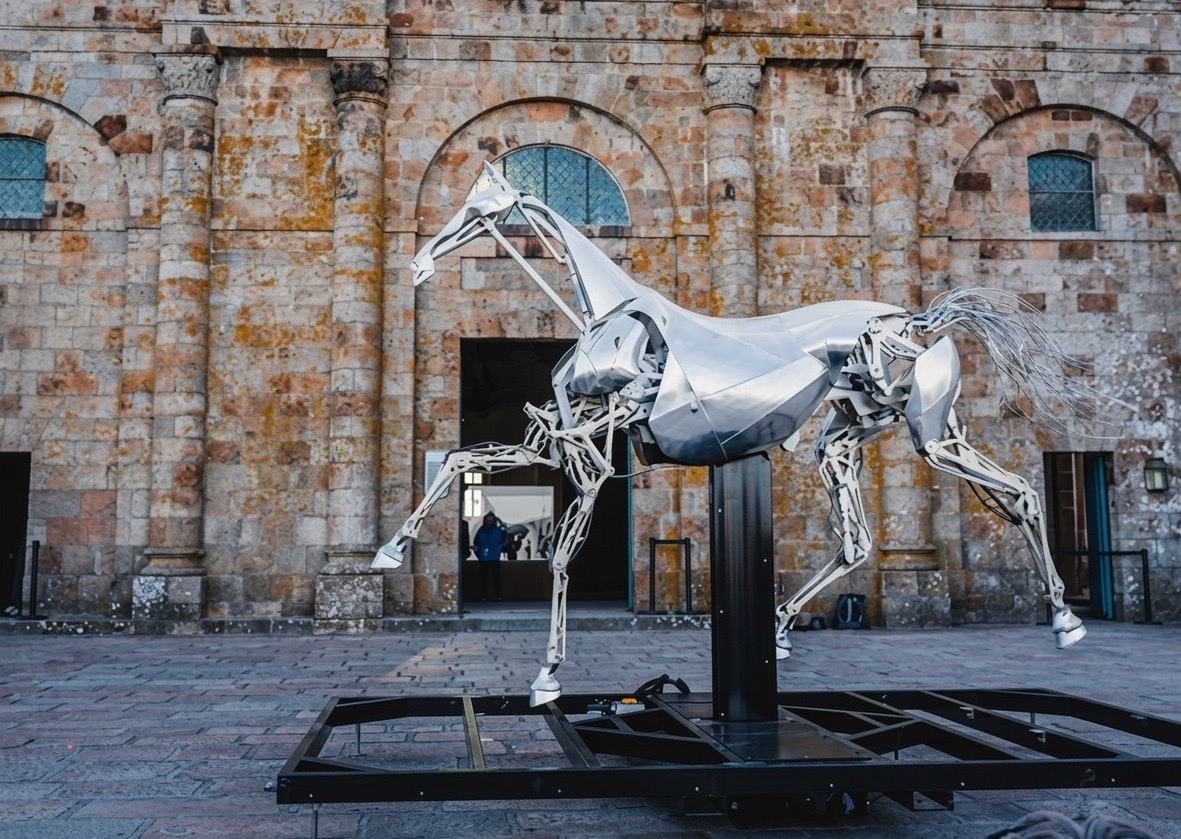
Modern sports design is moving away from mechanical fasteners in favor of fiber continuity and structural bonding. The Adhesives eliminate the need for drilling, reducing stress concentrations and increasing joint durability.
Furthermore, automation processes such as filament winding, automated fiber placement (AFP) and 3D printing are accelerating the transition from prototype to final product.
These elite solutions pave the way for more efficient production in the electric vehicle and aerospace sectors.
CompoTech PLUS and innovation in bicycle components
The company CompoTech PLUS has revolutionized bicycle components using automated fiber placement and helical winding. By using continuous fiber joints and eliminating metal fasteners, components such as handlebars and frames become lighter and more integrated.
This approach also reduces waste and production times.
Sustainable design without compromising performance
Environmental pressure has reached the world of sport, leading to an increase in biocomposites and natural materials. The challenge lies in integrating sustainability from the design phase, ensuring that structures remain mechanically competitive while being easier to recycle.
Bcomp and natural fibers
The Swiss company Bcomp is a leader in natural fiber solutions. Their technology ampliTex, based on flax, was presented at the Foiling SuMoth Challenge.
- Performance: Flax fibers offer excellent vibration damping and specific stiffness.
- Environment: They require less embodied energy during production.
- Collaboration: Bcomp promotes co-innovation between academia and industry to accelerate the adoption of these composite materials for sports in the marine and automotive sectors.
Huntsman ARALDITE® solutions for sports composite materials
The wide range of composite products from Huntsman ARALDITE® meets the strictest requirements in various sports sectors and helps athletes achieve performance at the highest level.
Huntsman Advanced Materials, a Mascherpa partner, offers a complete range of high-performance resin systems designed for the fabrication of composite material parts and their semi-finished products.
The processes in which Huntsman ARALDITE® products are applied include:
- filament winding;
- liquid infusion;
- wet lay-up;
- resin transfer molding;
- pultrusion;
- pre-impregnation.
Huntsman ARALDITE® products open new possibilities in the design and integration of systems, ensuring high strength, lightness, and an excellent stiffness-to-weight ratio, as well as high mechanical and thermal performance.

Mascherpa projects and solutions in composite materials for sports
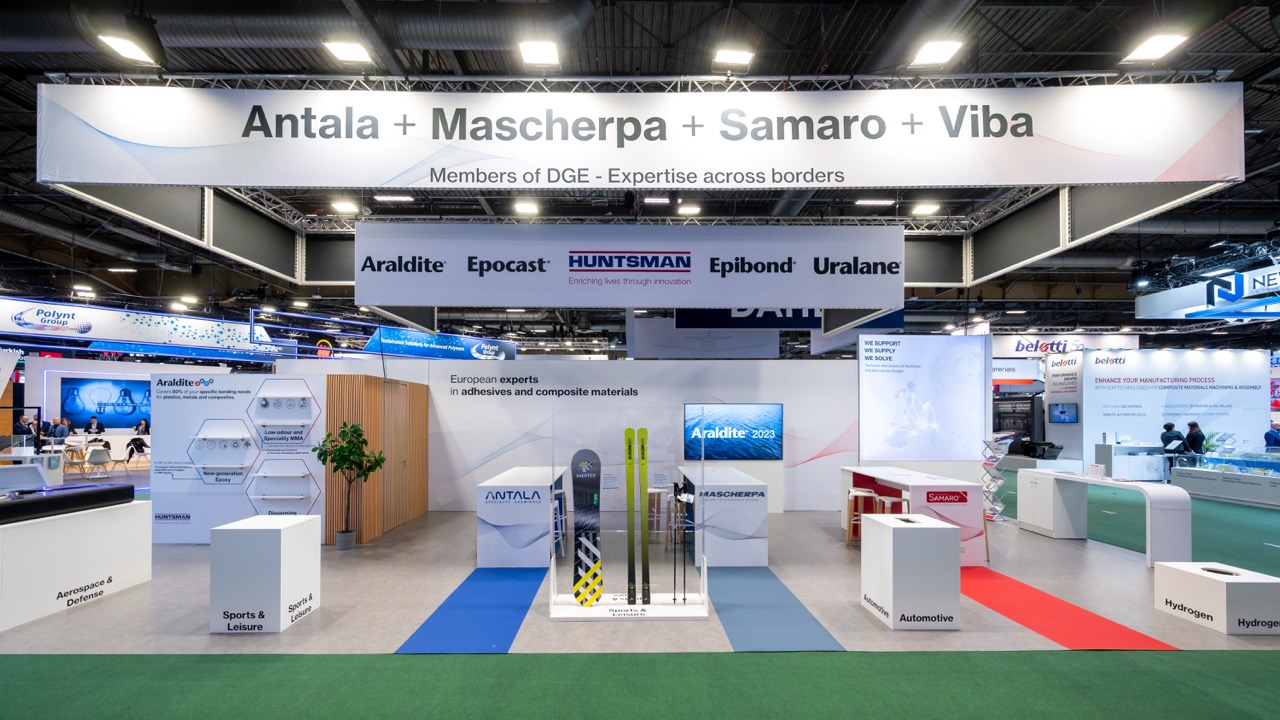
At JEC World 2026, Mascherpa presented several application projects developed alongside companies in the sports sector. Two concrete cases showing how the technical approach translates into effective solutions for materials and processes.
Dedicated solutions for Cober poles and rackets
Mascherpa supported Cober in the development of adhesive and structural solutions for composite material applications.
These include:
- Bonding of a foam EVA grip on polypropylene using Permabond TA4611 acrylic adhesive.
- Insertion of an aluminum cylinder inside a carbon racket using Araldite® 2011 epoxy adhesive.
A technical collaboration based on direct interaction, application testing and finding the most effective solution for each application.
Composite lamination for Blossom skis
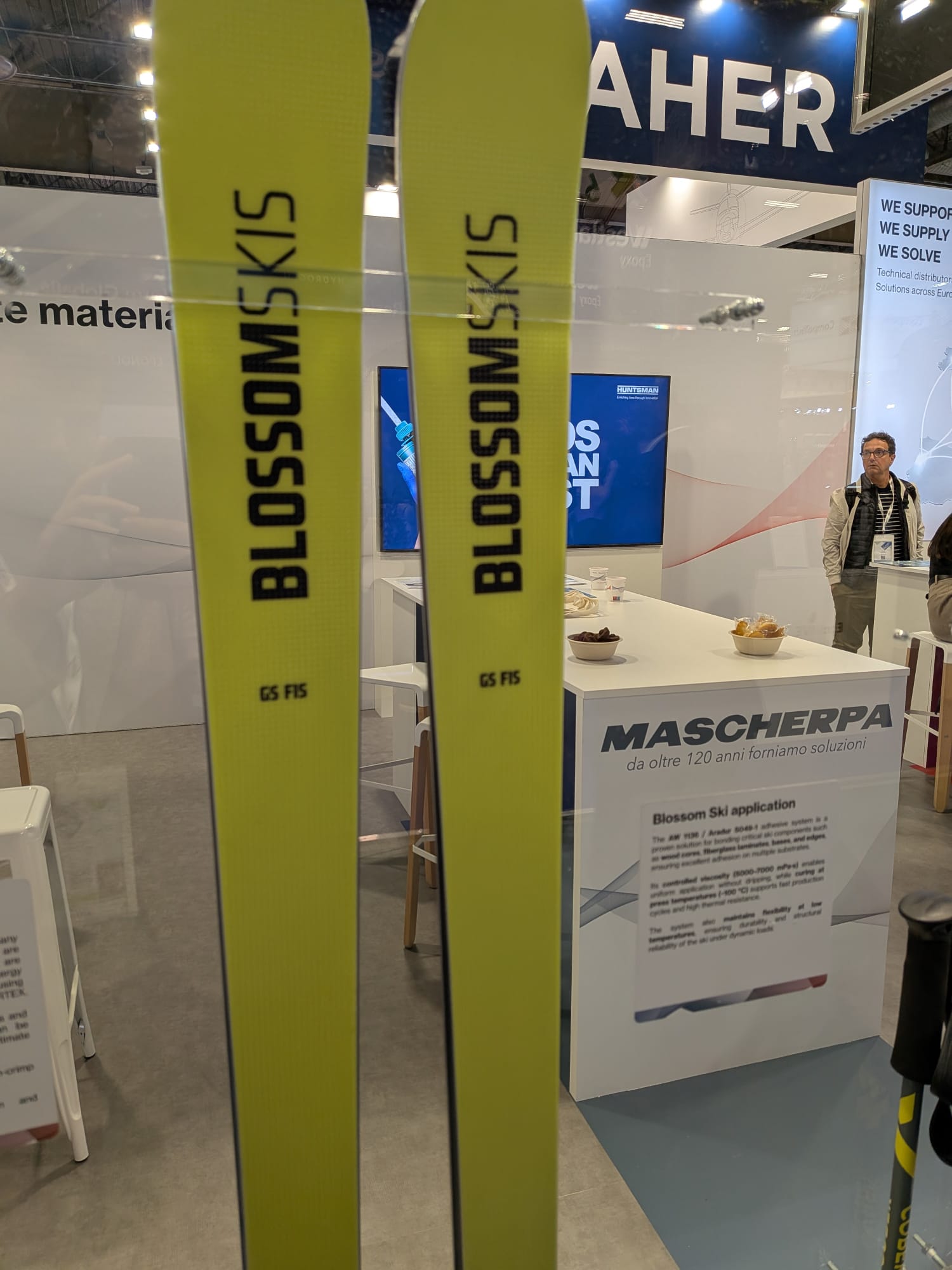
The production of skis is a complex structural process involving wood cores, edges, bases and fiber laminates. In this context, the lamination phase represents one of the most critical steps.
For this application, Mascherpa supported Blossom in selecting the system: ARALDITE® AW 1136 / ARALDITE® AW 1137 / ARADUR® 5049-1, a proven system in ski lamination that ensures:
- uniform application and controlled viscosity
- curing at approximately 100°C during molding
- excellent adhesion on different substrates
- retention of elongation at break at low temperatures
These features ensure production process stability and high structural performance even under the most demanding conditions of use.
JEC World 2026: the technological bridge for composite materials
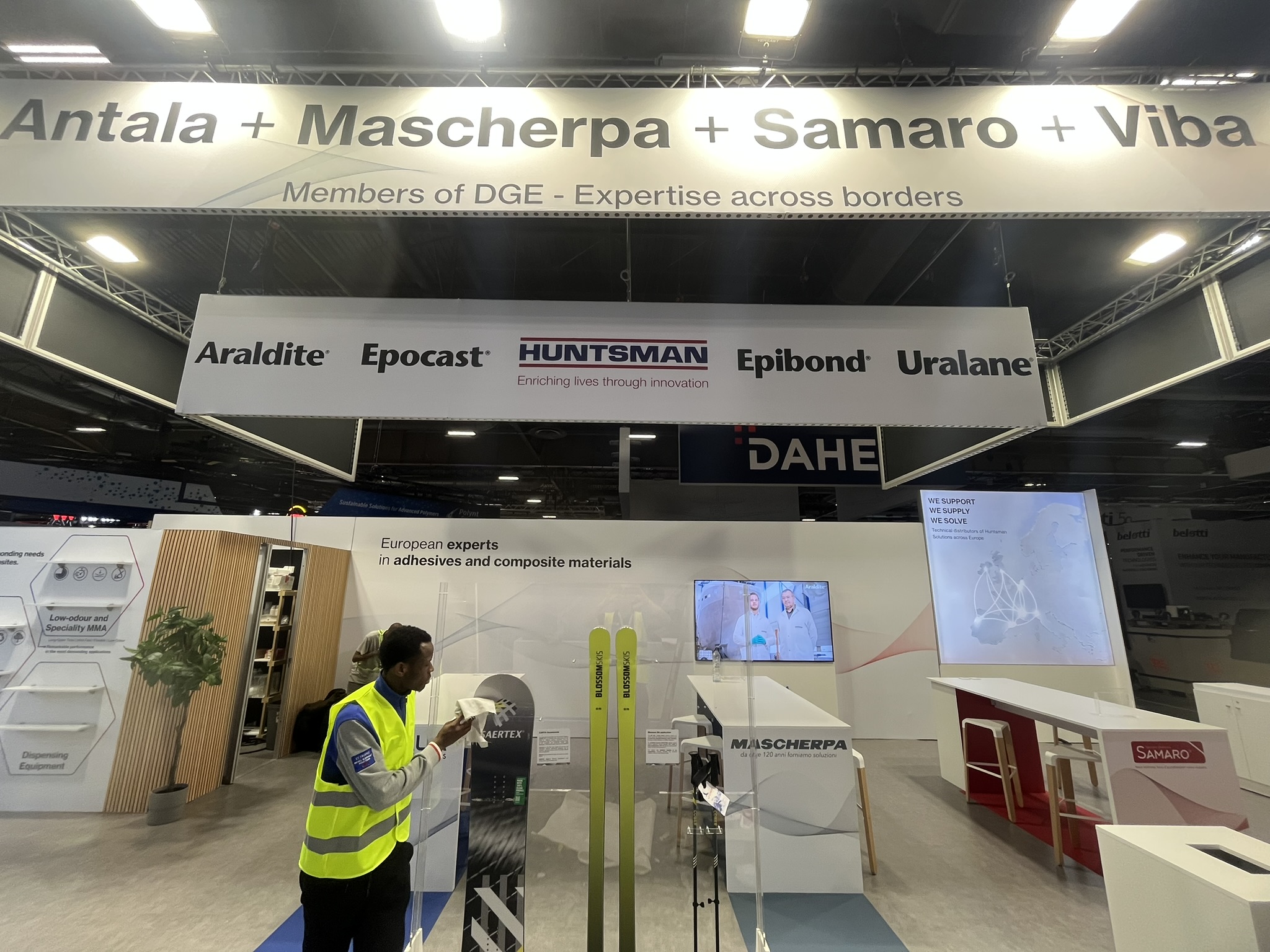
JEC World 2026 brought together designers, manufacturers and engineers from various sectors, including sports and leisure, aerospace and energy. A solution created for a kayak can easily inspire a new drone design or a component for a wind turbine.
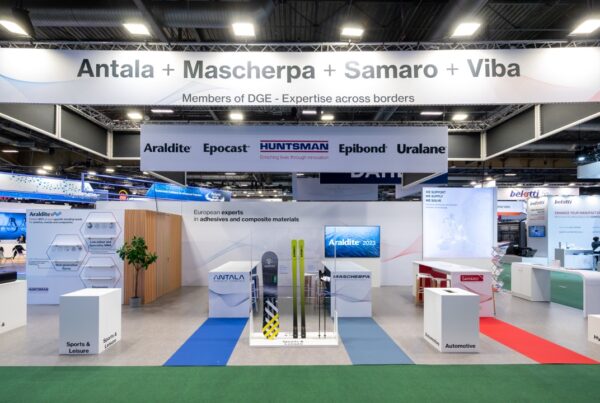
While sport provides urgency and rapid prototyping, industry provides scalability and certification. In this ecosystem, technical partners like Mascherpa, Antala, Samaro and VIBA provide essential value by connecting material manufacturers with specific industrial needs.
Looking to the future of composite materials
Sport is no longer just a game; it is a global technological showcase. The transition of solutions from the field or the track to the production line is redefining the limits of structural design and sustainability.
Contact Mascherpa Experts if you wish to explore how these technologies can be applied in your sector. We will help you find the best solution for your application.