Key points on outgassing
- Outgassing is the release of volatile compounds from a material and becomes particularly critical under vacuum conditions.
- The released compounds can condense on sensors, electronics, and other sensitive surfaces.
- ASTM E595 and ECSS-Q-ST-70-02C are key references for assessing materials intended for space applications.
- The TML, RML, and CVCM parameters make it possible to analyze mass loss and the fraction of potentially condensable volatile material.
- Four ARALDITE® adhesives met the general ECSS outgassing criteria. Alongside these are the DOWSIL™ solutions offered by Mascherpa for encapsulation in space environments.
In the aerospace sector, choosing a material means looking beyond its primary function. An adhesive must bond, an encapsulant must protect, and a lubricant must reduce friction and wear, but all of this must continue to take place in a vacuum, through temperature swings, and near electronics, sensors, and sensitive optical systems.
It is in this context that outgassing, or degassing, becomes a fundamental selection criterion. Volatile compounds released by a material can indeed migrate through the vacuum and deposit on other surfaces, with consequences that, on a satellite, can become difficult or impossible to correct after launch.
The topic is now even more relevant given the availability of new data on structural adhesives: four ARALDITE® systems have been screened according to ECSS-Q-ST-70-02C, meeting the general outgassing criteria set out in the standard.
Index
- What is outgassing?
- Why are low-outgassing materials needed in space?
- How is material outgassing assessed?
- New ECSS results for four ARALDITE® adhesives
- Low-outgassing solutions for satellites and space systems
- Real-world applications in the space sector
- Frequently asked questions about outgassing
- How to choose a low-outgassing material
What is outgassing?
Outgassing is the release of volatile compounds by a material. Under normal atmospheric conditions, the phenomenon may have a limited impact, but in a vacuum environment, the released substances can move away from the source surface, travel through the system, and reach other components.
The issue, then, is not just about the loss of a small part of the material’s mass. Some of the released compounds can condense on colder surfaces, forming deposits exactly where contamination should be kept to a minimum.
This is where the concept of low-outgassing comes from: it does not indicate the absolute absence of the phenomenon, but rather the need to select materials whose behavior in vacuum is compatible with the application and the limits required by the project.
An adhesive, sealant, or lubricant may therefore be perfectly adequate from a mechanical or functional standpoint, but not necessarily suitable for a space system if its release of volatile compounds has not been assessed.
Why are low-outgassing materials needed in space?
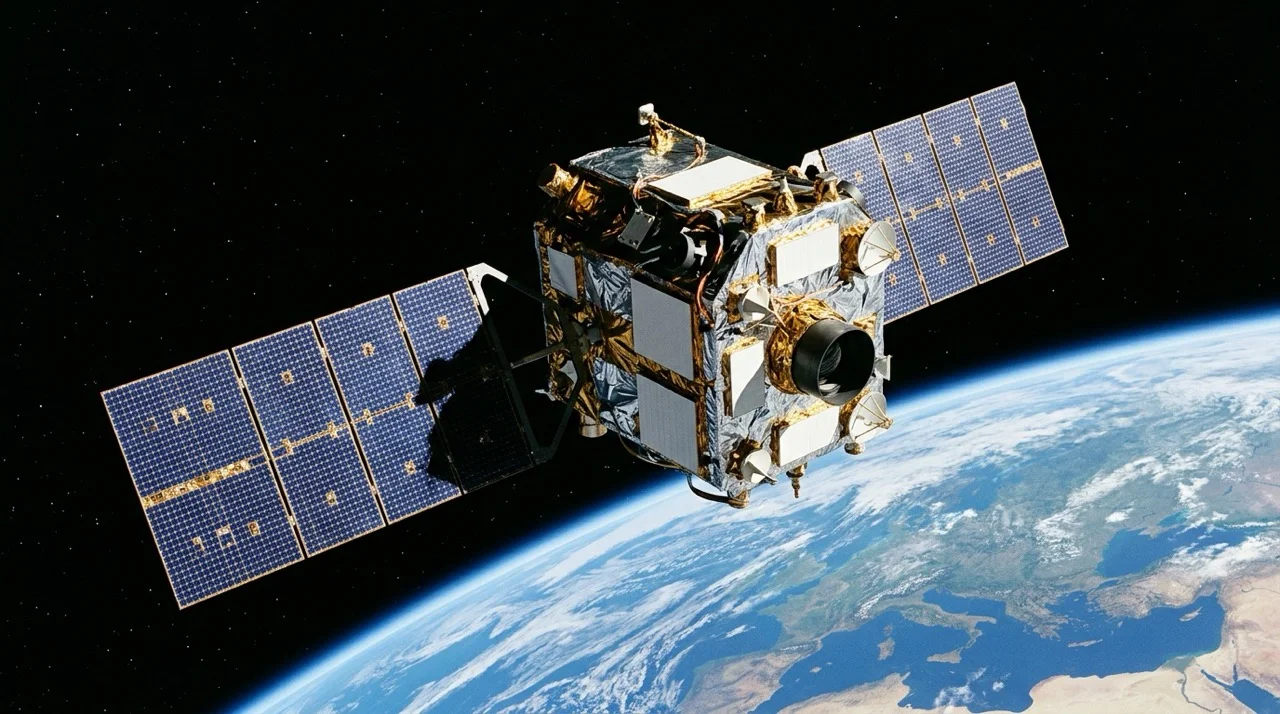
A satellite brings together components with very different requirements in a small space. Electronics, sensors, optics, wiring, thermal management systems, bearings, and actuators must work simultaneously under high vacuum, strong temperature swings, and extended operating cycles.
In this context, even small amounts of released material can become significant.
If a volatile compound reaches a colder surface and condenses, it can form micro-deposits. On a structural part, the effect may be negligible; on a lens, an optical sensor, or a surface with a precise thermal function, it can instead interferere with the expected performance.
This is why low-outgassing materials are not chosen simply because they “release less.” They are selected because they must reduce the risk of the material itself becoming a source of contamination for its surroundings.
There is also a second factor that makes the choice particularly delicate: once the system is in orbit, the possibilities for intervention become extremely limited or nonexistent. The compatibility of the material with the vacuum, the thermal cycle, and neighboring components must therefore be verified before launch.
How is material outgassing assessed?
Defining a product as “low-outgassing” without knowing the method by which it was assessed says little. To compare different materials, test methods are used that allow for the quantification of mass loss and, above all, the portion of volatile material that can condense on other surfaces.
Two key references for the space sector are ASTM E595 and ECSS-Q-ST-70-02C.
The first point to clarify is that these are not simple commercial labels. The test method establishes how the material’s behavior is measured, while the applicable specification for the project establishes which values must be met.
ASTM E595: TML and CVCM
ASTM E595 is used to assess the outgassing of materials subjected to controlled thermal vacuum conditions.
The sample is held for 24 hours at 125 °C in a high-vacuum environment of less than 7×10⁻³ Pa, so that both the overall mass loss and the amount of volatile material that can condense on a colder surface can be measured.
The two main parameters are:
- TML, Total Mass Loss, i.e., the total mass loss recorded during the test.
- CVCM, Collected Volatile Condensable Material, i.e., the amount of condensable volatile material collected.
The difference is important. TML indicates how much material is lost; CVCM, on the other hand, helps to understand how much of what is released can turn into a potential source of contamination for other components.
For NASA applications, the following are used as reference thresholds:
| Parameter | Reference value |
| TML | ≤ 1.0% |
| CVCM | ≤ 0.10% |
ASTM E595 should therefore be considered a test method. To determine if a material is usable, the results must then be compared with the requirements set by the specification or program.

ECSS-Q-ST-70-02C and RML
In the European space sector, ECSS-Q-ST-70-02C is one of the references used for the selection of materials in relation to outgassing.
The test conditions are similar to those set out in ASTM E595, and the results are generally comparable for screening purposes. In the ECSS assessment, however, RML, Recovered Mass Loss, also comes into play, which considers the mass loss after post-conditioning and moisture recovery.
The general criteria used for material selection are:
| Parameter | General criterion |
| RML | < 1.00% |
| CVCM | < 0.10% |
This step matters because it allows the material choice to be based on measured data, rather than on a generic definition of “low degassing.”

New ECSS results for four ARALDITE® adhesives
Outgassing control also applies to structural adhesives. Four epoxy systems ARALDITE® were recently screened according to ECSS-Q-ST-70-02C:
- ARALDITE® 2013-2
- ARALDITE® 2014-3
- ARALDITE® AV 138M-1 / Hardener HV 998-1
- ARALDITE® AV 138M-2 / Hardener HV 998-1
During the test, TML, RML, and CVCM were measured. The most important finding for selection purposes is that all four systems meet the general ECSS criteria set for RML and CVCM.
The results for the two parameters used in the general criteria are:
| Product | RML | CVCM |
| ARALDITE® 2013-2 | 0.952% | 0.033% |
| ARALDITE® 2014-3 | 0.616% | 0.010% |
| ARALDITE® AV 138M-1 / HV 998-1 | 0.606% | 0.011% |
| ARALDITE® AV 138M-2 / HV 998-1 | 0.667% | 0.002% |
Among the four products, ARALDITE® 2014-3 is of particular interest for space applications where bonding performance must be paired with documented behavior in terms of outgassing. The measured values, an RML of 0.616% and a CVCM of 0.010%, remain within the general criteria set by the standard.
The point, however, isn’t to identify an absolute “best” product. All four systems passed screening against the stated criteria, and adhesive selection still needs to take into account:
- substrates,
- joint geometry,
- application process,
- operating conditions,
- program-specific requirements.
The new data therefore adds a further technical criterion to adhesive selection, without replacing the evaluation of the application as a whole.
Low-outgassing solutions for satellites and space systems
Outgassing control control does not end with bonding. A satellite can contain materials with very different functions, and each must be assessed for the risk of release and contamination.
The same principles therefore apply to encapsulants and sealants.
DOWSIL™ for low-outgassing encapsulation and sealing
Protecting an electronic circuit means isolating and stabilizing the component without introducing a new risk factor for sensors, optics, or other sensitive surfaces.
DOWSIL™ 93-500 Space Grade Encapsulant is a space-grade encapsulant compliant with specification NASA SP-R-0022A, with a stated operating range between -115 °C and +200 °C.
The range also includes materials developed for different functions. DOWSIL™ 6-1104 Controlled Volatility Sealant, for example, is a controlled-volatility sealant evaluated for low-outgassing applications according to ASTM E595.
In both cases, the principle remains the same: the ability to protect or seal the component must be accompanied by behavior compatible with the vacuum environment.
Real-world applications in the space sector
Outgassing parameters parameters take on a much more immediate meaning when linked to what can actually happen inside a satellite.
DOWSIL 93-500 for a satellite
A manufacturer of modules for observation satellites experiences degradation of optical sensors due to micro-deposits of CVCM generated by the outgassing of conventional encapsulants in vacuum.
Replacement with DOWSIL 93-500, a NASA SP-R-0022A certified space-grade encapsulant, which passes ASTM E595 tests, ensuring optical and electrical stability for the entire life of the satellite.
This case highlights a key point: an encapsulant can’t be assessed solely on the protection it provides to electronics. When optical sensors are nearby, its low-outgassing behavior also becomes part of the required performance.

SYLGARD 184 for space optics
An astronomical research institute institute needs to bond pairs of large-diameter lenses for an instrument in a thermally variable environment, with zero mechanical stress and transparency between 370 and 1700 nm.
Adoption of SYLGARD 184, a transparent silicone optical adhesive that minimizes stress from differing coefficients of thermal expansion without optical absorption.
This third example also helps to put the topic of outgassing into the correct perspective. Low-outgassing is an important requirement in space applications, but it is not the only one: optical properties, thermal compatibility, electrical characteristics, and mechanical behavior must be evaluated together.

Frequently asked questions about outgassing
What causes outgassing?
Outgassing occurs when a material releases volatile substances present within it. The phenomenon becomes particularly significant under vacuum conditions, where these compounds can be released and migrate more easily to other parts of the system.
This is why a material’s behavior has to be assessed with the actual conditions of use in mind.
What happens during outgassing?
During outgassing, some of the volatile compounds present in the material are released into the surrounding environment.
In a vacuum, these substances can travel and then condense on colder surfaces. It’s precisely this ability to form deposits on other components that makes the phenomenon critical in space applications.
What is an example of outgassing?
A typical example is a material used near an optical sensor inside a satellite.
If the encapsulant or sealant releases volatile compounds in a vacuum, these can migrate and deposit on the surface of the sensor or a lens, potentially altering its performance. This is one of the reasons why low-outgassing materials are selected for these applications.
What does low-outgassing mean?
Low-outgassing indicates a material characterized by a limited release of volatile compounds under the conditions expected for the application.
It doesn’t mean “zero outgassing,” but rather controlled behavior that has been assessed through specific tests. In the space sector, this helps reduce the risk of the material becoming a source of contamination for nearby components.
How do you check whether a material is low-outgassing?
This behavior is verified through tests carried out under controlled thermal vacuum conditions.
Methods such as ASTM E595 and ECSS-Q-ST-70-02C allow for measuring how much mass is lost and how much of the released compounds can condense. The results are then compared with the criteria required by the applicable specification or program.
How to choose a low-outgassing material
There is no single low-outgassing material suitable for every space application.
The choice changes radically depending on whether the goal is to create a structural joint, protect an electronic circuit, seal a component, or ensure the lubrication of an actuator for the entire mission.
The data obtained through ASTM E595 or ECSS-Q-ST-70-02C therefore constitute one part of the selection process. They must be read together with temperature, vacuum level, operating duration, proximity to optics and sensors, component geometry, materials involved, and the application process.
Documentation also needs to be verified against the specific application, since specifications, revisions, batch, and packaging can affect the qualifications available.
It is within this framework that solutions such as ARALDITE® adhesives and DOWSIL™ encapsulants and sealants fit in, each with a different role within the system.
For Aerospace & Defence applications, Mascherpa experts can support the verification of the material, technical documentation, and the specification most consistent with the actual conditions of your project. For more information, contact the Mascherpa experts or visit our new section dedicated to Aerospace & Defence solutions.