Key Points
- Orion rocket almost entirely made of composite material, with new challenges in bonding between different materials.
- The bonds become a fundamental structural element, transmitting loads and moments during flight.
- Thickness and concentricity control without jigs, thanks to the integrated spacers of the epoxy adhesive.
- The epoxy adhesive Araldite® 4858 ensures mechanical strength and load transmission, even under critical operating conditions.
- Applications of composite materials on tank and fincan, where adhesion and process determine the system performance.
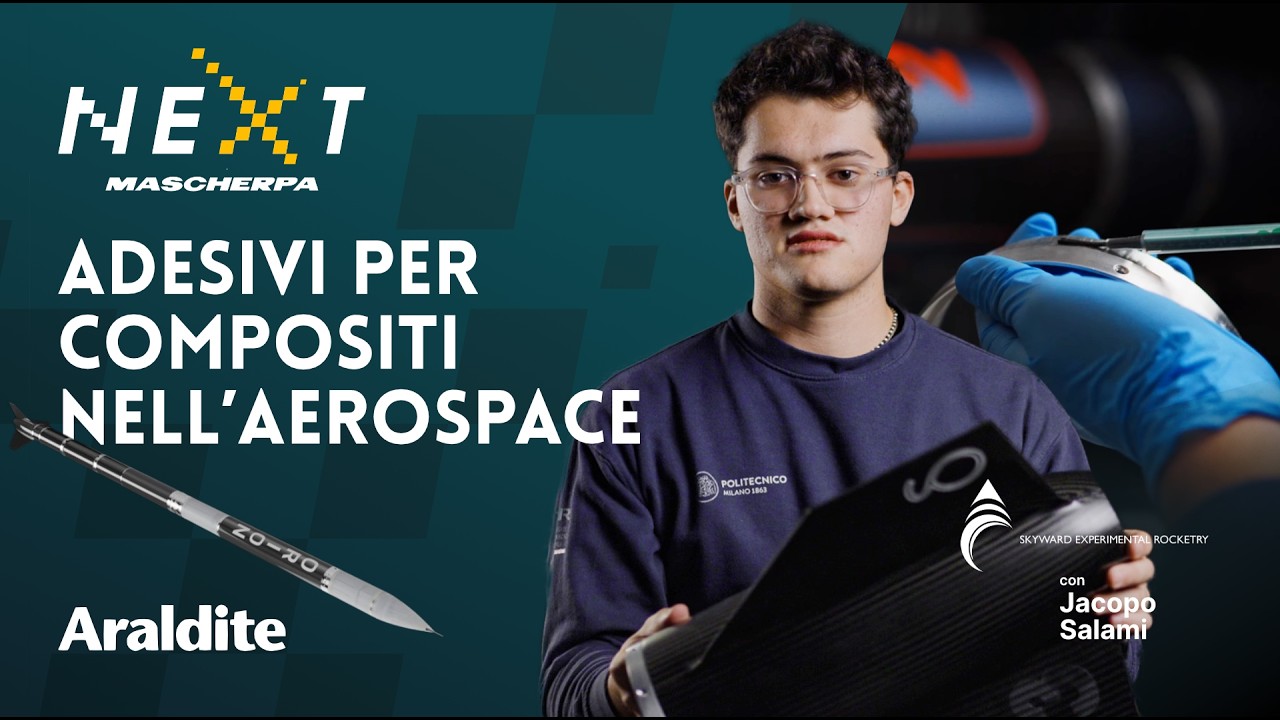
Skyward Experimental Rocketry is an association of the Politecnico di Milano that develops sounding rockets for international competitions such as EUROC. Within this context, the Orion rocket project introduced a significant evolution in structural design.
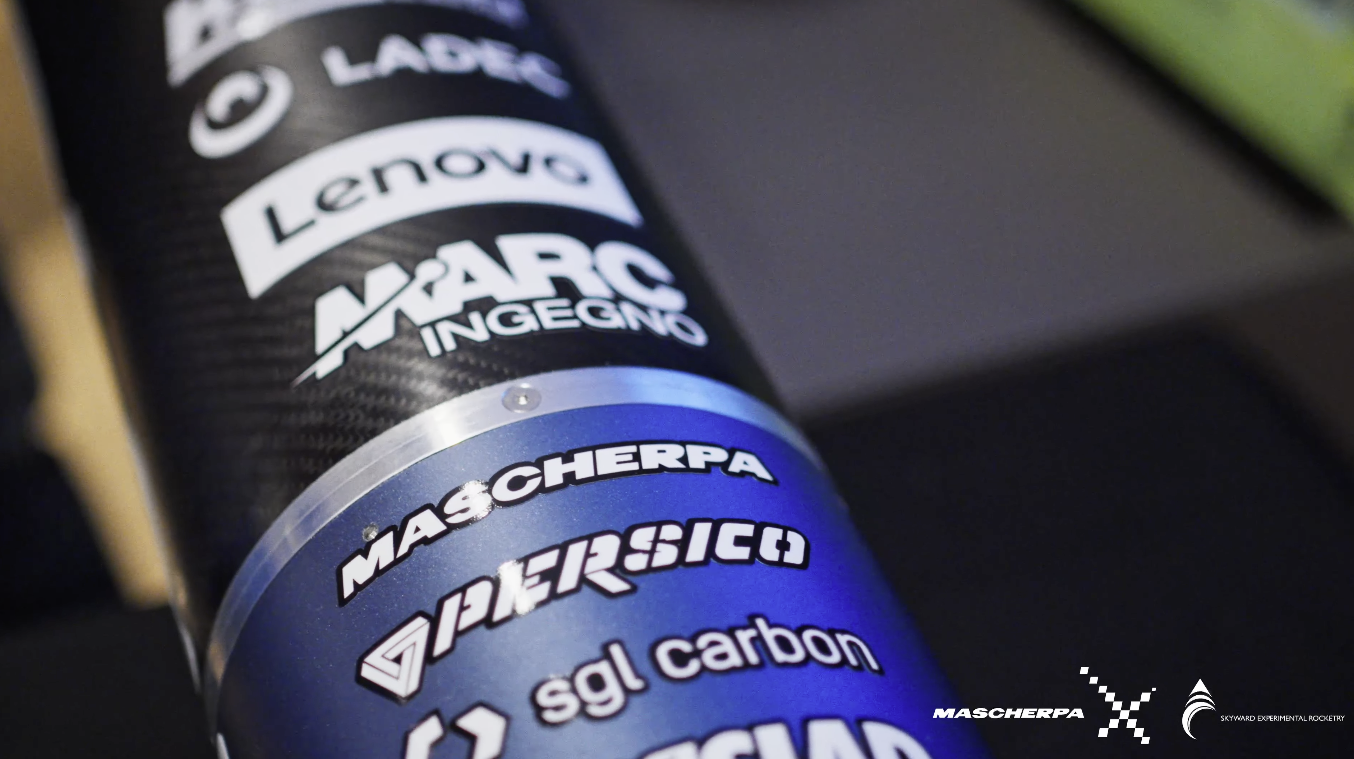
As a partner, Mascherpa supported the team in selecting materials and solutions for critical applications, including structural bonding and composite material components, contributing to the development of a rocket almost entirely manufactured with these technologies.
Index
- A Rocket Built Almost Entirely with Composite Materials
- Why Bonding Is a Critical Structural Element
- The Adhesive Choice for the Orion Rocket: Araldite® 4858
- Applications of Araldite® adhesive on filament winding tanks
- Fincan in Composite Material: A Single Component to Withstand Stress and Vibrations
- The Value of Technical Consulting in Composite Materials
- Composite Materials and Bonding in Real Applications
A Rocket Built Almost Entirely with Composite Materials
The Orion rocket project represents a change in approach compared to previous configurations. The rocket was manufactured entirely in composite material, with the exception of the aluminum connection flanges.
This choice introduced new challenges, particularly related to bonding between different materials, which becomes a central structural element.
Why Bonding Is a Critical Structural Element
In the case of the Orion rocket, the bonding is not simply a connection between components, but a fundamental element for the structural behavior of the rocket.
During flight, especially during the apogee and parachute deployment phases, significant moments and forces are generated on the flanges and on the airframes. These loads are transmitted precisely through the bonds, making the surface quality of adhesion and the resin used essential.
A further critical aspect concerns geometric precision. The components of the airframe are developed with very tight tolerances and the bonding with the flanges requires maintaining concentricity, without the use of jigs or dedicated tooling.
The Adhesive Choice for the Orion Rocket: Araldite® 4858
To meet these requirements, Mascherpa supported the Skyward Experimental Rocketry team in selecting a two-component epoxy adhesive, Araldite® 4858.
One of the determining elements was the control of the bond line thickness, especially in the manufacturing of highly precise components for the rocket airframes and for the bonding of connection flanges.
The integrated spacers in the product made it possible to obtain a thin and uniform layer, essential for maintaining concentricity between components without the use of jigs or dedicated instrumentation.
The choice of Araldite® 4858 was also guided by the room temperature strength of the epoxy adhesive. The rocket is subjected to significant loads and the adhesive must ensure effective transmission of stresses between bonded parts.
In particular, during the apogee phase and parachute deployment, high moments are generated on the flanges and on the airframes, which are transferred directly through the bonds.
For this reason, having an adequate bonding surface and an adhesive with high mechanical performance is essential to ensure structural continuity and proper transmission of loads.
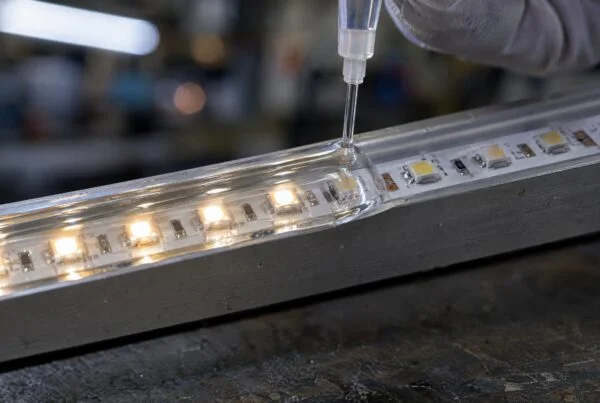
From an application standpoint, the resin system allows immediate mixing thanks to the nozzle, making it possible to use only the required amount of product.
L’application is made faster also by the gun that the Mascherpa team provided to the team, while the pot life of approximately 60 minutes provides the necessary time to position the components e manage alignments.
Applications of Araldite® Adhesive on Filament Winding Tanks
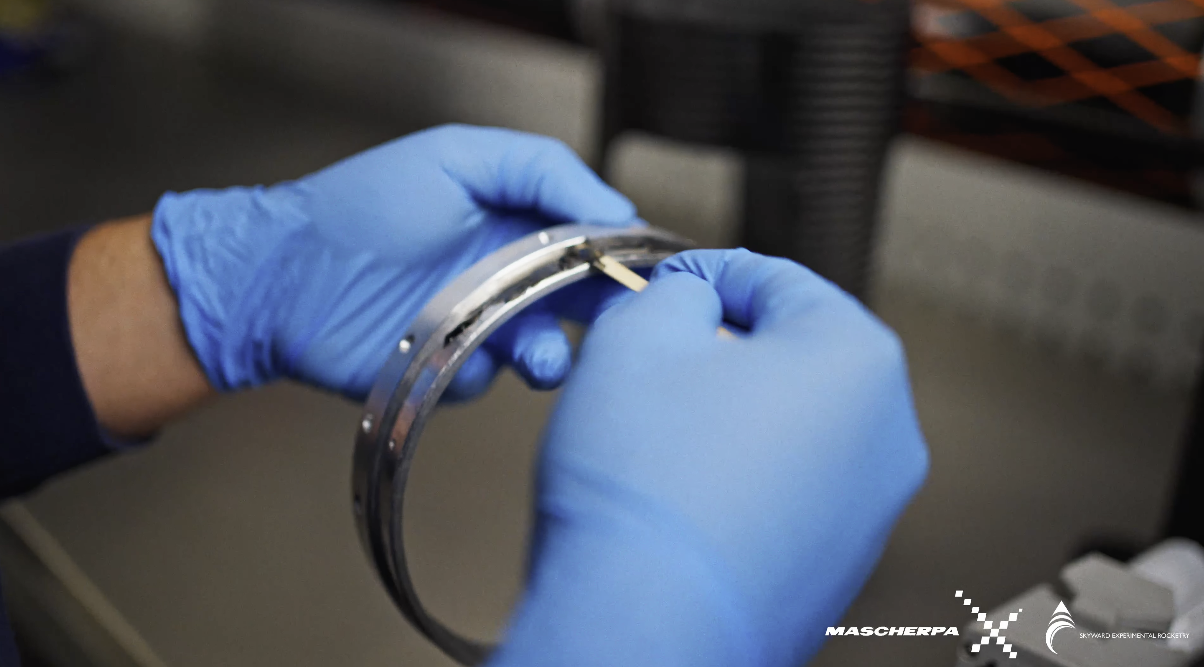
One of the components developed is the tank manufactured using filament winding, with external surface in carbon fiber and epoxy resin.
On this structure, the aluminum connection flanges are bonded. The application of the Araldite® adhesive occurs on a curved surface that follows the dome geometry, making the bonding particularly delicate.
It is also a critical component, both due to the pressure to which it is subjected, and because it is positioned at the center of the rocket. In this position, during parachute deployment, it is subjected to moments and significant forces.
Under these conditions, the bonding quality and the resin adhesion become critical for overall performance.
Fincan in Composite Material: A Single Component to Withstand Stress and Vibrations
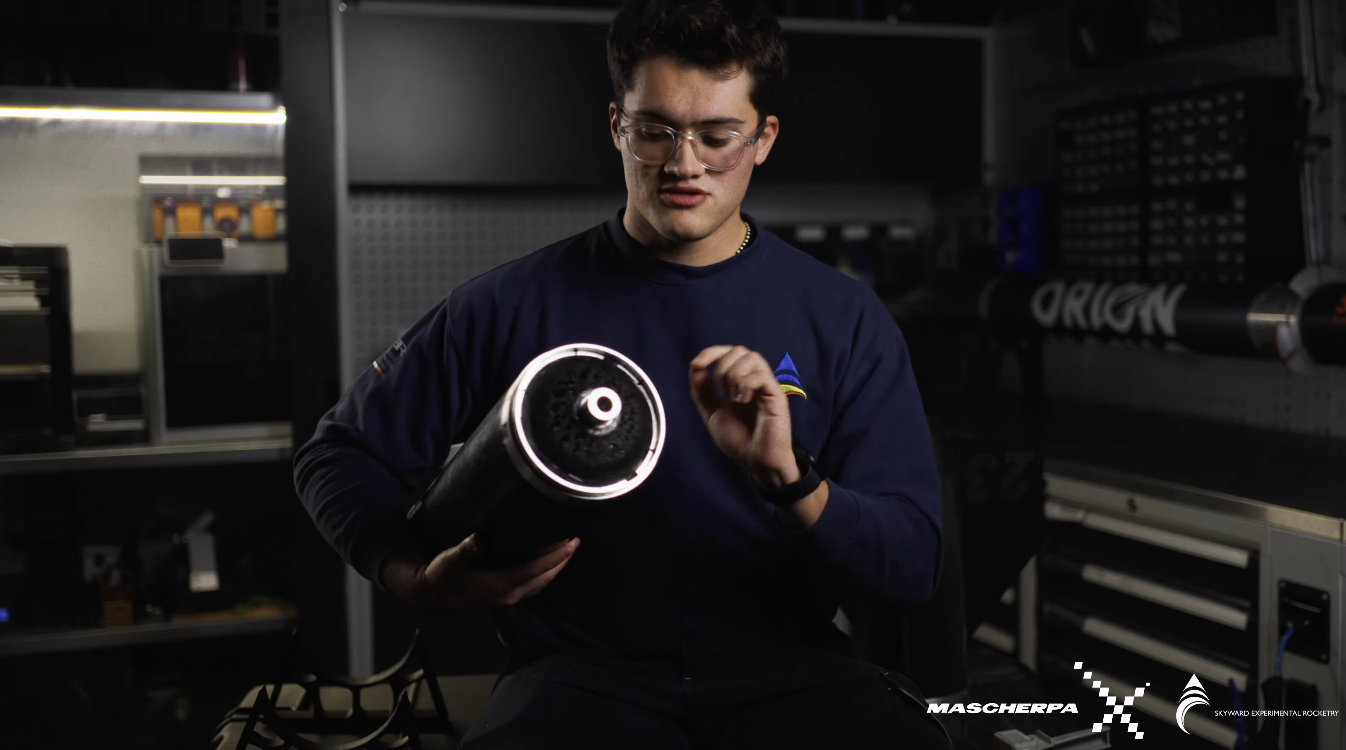
Another key element is the fincan, namely the boattail and taper section, near the nozzle, which also integrates the combustion chamber area and the fins.
In this case, the main innovation was the manufacturing of the component in a single piece. Starting from a mold in three parts, it was possible to obtain a completely laminated structure without intermediate joints.
Here too, the aluminum connection flange is bonded using Araldite® 4858.
The result obtained ensured resistance to both mechanical stress and aerodynamic and aeroelastic vibrations to which the component is subjected.
The Value of Technical Consulting in Composite Materials
The Orion rocket project highlights how, in composite applications, the adhesive selection and the process management of bonding are as critical as the material itself.
The technical support Mascherpa made it possible to identify a solution capable of meet the requirements of precision, resistance e reliability required by a high-performance system such as a sounding rocket.
Composite Materials and Bonding in Real Applications
The experience with Skyward Experimental Rocketry demonstrates concretely how composite materials and structural bonding can be successfully applied even in extreme operating conditions.
In this type of project, the result does not depend only on the material, but on the ability to correctly integrate product, process and application. And it is precisely on this balance that the value of effective technical support is built.
For more information on the Orion rocket project and other projects followed together with university institutions, visit the Mascherpa Next page or contact our Mascherpa experts.