Key points of the article
- The filament winding process is the reference method for manufacturing high-performance composite material structures.
- The selection of fibers, resins, and volume fractions determines the final properties of the laminate.
- Pot life, control of the thermal ramp, and environmental management directly impact quality and production continuity.
- Prepregs and auxiliary materials reduce process variability and improve repeatability and surface finish.
- Filament winding is central to strategic sectors such as Oil&Gas, aerospace, energy, and hydrogen mobility
In the Oil&Gas sector, pressure vessels used to store hydrocarbons or gases are traditionally manufactured in steel.
However, poor resistance to corrosion and the need for increasingly lightweight structures have driven the industrial world toward alternative materials. Among these, composite materials now represent the best compromise between lightness, mechanical strength, and durability.
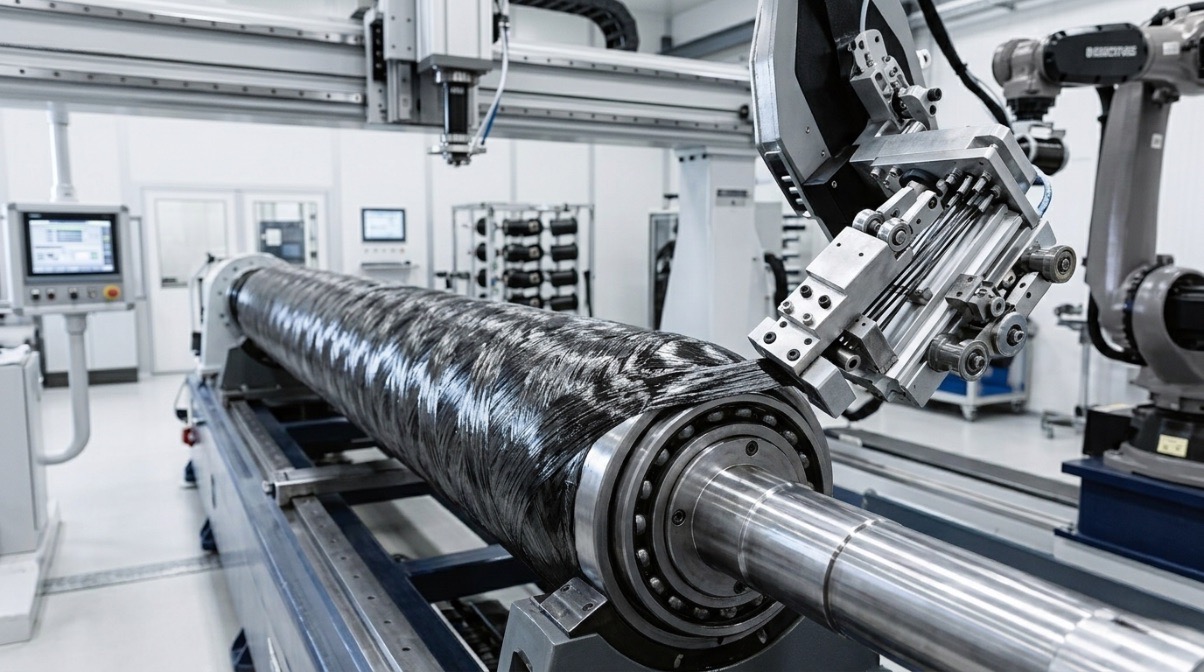
The manufacturing process that has enabled this evolution is filament winding, the molding process most commonly used for manufacturing tanks and pressure vessels in carbon fiber and other advanced composite materials.
Index
- The Evolution of Materials: From Metals to Fiber Composites
- What Is Filament Winding
- Thermal Ramp and Bubble Formation in the Filament Winding Process
- Filament Winding with Prepreg and Advanced Applications
- Resin Systems for Filament Winding
- The Role of the Filament Winding Process in the Evolution of Oil&Gas Vessels
- Industries Where the Filament Winding Process Is Essential
- Mascherpa’s Role in the Filament Winding Process
- Mascherpa Solutions for the Composites World at JEC World
The Evolution of Materials: From Metals to Fiber Composites
Composite pressure vessels are constructed with high-strength fibers:
- carbon fiber;
- glass fiber;
- aramid.
These materials offer:
- strength-to-weight ratios significantly superior to steel;
- high corrosion resistance;
- predictable and optimizable elastic and mechanical performance.
Starting from the analysis of the elastic and mechanical properties of the fibers, the matrix, and the volume fractions, it is possible to evaluate the final characteristics of the laminate and design high-performance structures.
It is precisely at this stage that the filament winding process becomes critical.
What Is Filament Winding
The filament winding process consists of winding resin-impregnated fibers around a mandrel according to predetermined patterns and angles, until the desired layup is achieved.
It is the molding process most commonly used for the production of pressure vessels in composite materials.
Filament winding machines can operate according to two main methods:
- wet filament winding (with liquid resin)
- filament winding with pre-impregnated yarns (prepregs)
Both solutions require precise control of materials and process parameters.
Wet Filament Winding: Liquid Resins and Pot Life Management
Alongside traditional wet filament winding, towpreg filament winding is gaining increasing adoption, particularly in the production of hydrogen pressure tanks and high-productivity applications.
The process uses pre-impregnated fibers (towpreg) with a resin system already controlled in the preliminary phase. This allows:
- cleaner processing compared to wet winding;
- greater uniformity of resin content;
- high winding speeds;
- reduced curing times.
These systems are designed to ensure good processability, stability at room temperature, and rapid curing, while maintaining high mechanical performance and resistance in hot/wet conditions.
Towpreg Filament Winding: Process Evolution
Alongside traditional wet filament winding, towpreg filament winding is gaining increasing adoption, particularly in the production of hydrogen pressure tanks and high-productivity applications.
The process uses pre-impregnated fibers (towpreg) with a resin system already controlled in the preliminary phase. This allows:
- cleaner processing compared to wet winding;
- greater uniformity of resin content;
- high winding speeds;
- reduced curing times.
These systems are designed to ensure good processability, stability at room temperature, and rapid curing, while maintaining high mechanical performance and resistance in hot/wet conditions.
Thermal Ramp and Bubble Formation in the Filament Winding Process
During the winding phase and subsequent heat treatments, suboptimal control can lead to the formation of surface bubbles. The consequences of these imperfections can be:
- aesthetic defects;
- compromises in subsequent operations (bonding, finishing);
- functional issues in specific cases.
The recommendation is to carefully evaluate the thermal ramp and precisely control temperature and ambient humidity.
In particular, in the combination of epoxy resins with amine hardeners, improper environmental management can generate surface opacification. To mitigate these risks, Mascherpa offers peel plies or heat-shrinkable films from the Diatex range. These products:
- compact the part;
- eliminate surface bubbles;
- ensure glossy surfaces;
- prepare the part for secondary operations such as painting or bonding.
Filament Winding with Prepreg and Advanced Applications
Wet filament winding can create complex working environments if not properly structured.
For this reason, prepreg systems represent a strategic alternative. With these materials, the yarns are already resin-impregnated, the impregnation phases are controlled upstream, and process variability is reduced.
Mascherpa, through the companies it represents, offers resin systems and prepregs specifically developed for:
- filament winding;
- fiber placement.
These solutions enable greater control, cleanliness, and process repeatability.
Resin Systems for Filament Winding
In the filament winding process, the selection of the resin system is critical to ensure laminate quality, process stability, and final mechanical performance.
Mascherpa offers ARALDITE® epoxy systems specifically formulated for filament winding processes. These include:
- ARALDITE® LY 1564 / ARADUR® 917
- ARALDITE® LY 1135-1 / ARADUR® 917-1
- ARALDITE® LY 3588 / ARADUR® 3588
- ARALDITE® LY 30012 CI / ARADUR® 30013 CI
- ARALDITE® LY 30030 CI / ARADUR® 30031 CI
These are systems with varying viscosity and reactivity, designed to optimize impregnation, control curing, and thermal performance of the finished part, including formulations with high elongation for structural applications.
These solutions enable the process to be adapted to production requirements: from traditional low-viscosity winding to systems designed for high-speed rotators.
The Role of the Filament Winding Process in the Evolution of Oil&Gas Vessels
Composite pressure vessels now represent a vital component for the storage and transport of gases and hydrocarbons, enabling advanced energy applications.
The combination of carbon fiber, composite resins, and the filament winding process enables the production of lightweight, strong, and durable tanks.
Industries Where the Filament Winding Process Is Essential
The filament winding process is applied in highly technical sectors where precision, repeatability, and material control are critical.
In the aerospace sector, it is used for manufacturing structural components such as launch vehicles, where winding quality and process customization directly impact final performance.
In the hydrogen mobility sector, filament winding is central to the production of Type IV tanks, which require high precision and winding speed to ensure productivity and safety.
In theenergy, filament winding sector, it is applied in the production of structural components e pressure vessels intended for wind power plants, energy storage systems and infrastructure for the energy transition.
In particular, in the production of wind turbine blades and turbine components, composite materials enable weight reduction of structures while maintaining high mechanical properties and fatigue resistance.
The high reproducibility of the process and the ability to precisely control fiber orientation make filament winding a strategic solution for energy applications where reliability and long-term durability are essential requirements.
Mascherpa’s Role in the Filament Winding Process
Mascherpa does not position itself as a simple distributor of resins or fibers, but as a technical consultant in managing critical issues related to the filament winding process and other critical processes involving composite materials.
Through the products in its portfolio and the experience gained over more than 120 years of activity, it ensures:
- support in selecting the resin systems best suited to different applications;
- solutions for controlling pot life;
- auxiliary composite materials for compaction;
- prepreg systems for controlled processes;
- consulting in managing production issues.
The objective is to ensure mechanical performance, surface quality, and production continuity in composite material parts.
Mascherpa Solutions for the Composites World at JEC World
Mascherpa will be present from March 10 to 12 at the JEC World 2026 trade fair in Paris, at the DGE stand, showcasing solutions for the composite materials world, with a particular focus on composite resin systems from Huntsman ARALDITE®.
For more information about the composite solutions available on the Mascherpa website, visit the Mascherpa Expert page or contact our experts.