Key points on train wheelset lubrication
- The wheel-axle assembly in trains takes place through press-fitting which requires the control of friction between the surfaces.
- Correct cleaning of the contact areas precedes the application of the assembly paste on the axle.
- MOLYKOTE® G-N Plus promotes a more consistent pressing and helps prevent scoring and fretting corrosion.
- The high load-carrying capacity is verified by testing with a four-ball machine according to DIN 51350.
- The pressing curve allows for monitoring the process progress and verifying compliance with the required parameters.
In the railway sector, wheel lubrication can involve different stages.
During operation, specific products are used to manage wheel-rail contact and flange lubrication. Before the train enters service, however, there is another critical phase: assembling the wheels onto the axles.
Assembly is performed via a press-fit coupling. The metal surfaces are subjected to high loads and slide against each other at low speed. Under these conditions, the use of specific assembly pastes helps to control friction, facilitate pressing, and protect the surfaces involved.

Index
- What is meant by train wheel-axle assembly and lubrication?
- Why control friction in press-fitting?
- How train wheel-axle assembly takes place
- The role of anti-seize pastes in coupling
- All the properties of MOLYKOTE® G-N Plus for wheel-axle assembly
- Automatic lubrication in railway applications
- Controlling the process to protect wheels and axles
What is meant by train wheel-axle assembly and lubrication?
The assembly of the axle with the wheel concerns fitting, i.e., the press-fitting of the wheel onto the axle. In this phase, the lubricant is not intended for subsequent contact with the rail, but must support the controlled sliding of the surfaces during coupling.
It is in this application that anti-seize assembly pastes come into play.
Why control friction in press-fitting?
Train wheel-axle assembly requires the wheel to be pushed progressively onto the axle seat.
During pressing, the metal surfaces come into contact under high pressures and low speeds. A specific lubricating paste forms a film between the components and helps to reduce the friction generated during advancement.
Friction control promotes more consistent pressing and helps limit phenomena such as:
- surface scoring;
- seizing during coupling;
- fretting corrosion;
- irregularities in the sliding between wheel and axle.
The choice of assembly paste therefore becomes an integral part of the train axle assembly process.
How train wheel-axle assembly takes place
The correct use of axle lubricants depends not only on the product characteristics, but also on the preparation of the surfaces and the method of application. The different application phases of the anti-seize paste are explained below MOLYKOTE® G-N Plus, suitable for wheel and axle assembly in the railway sector.
Surface preparation and cleaning
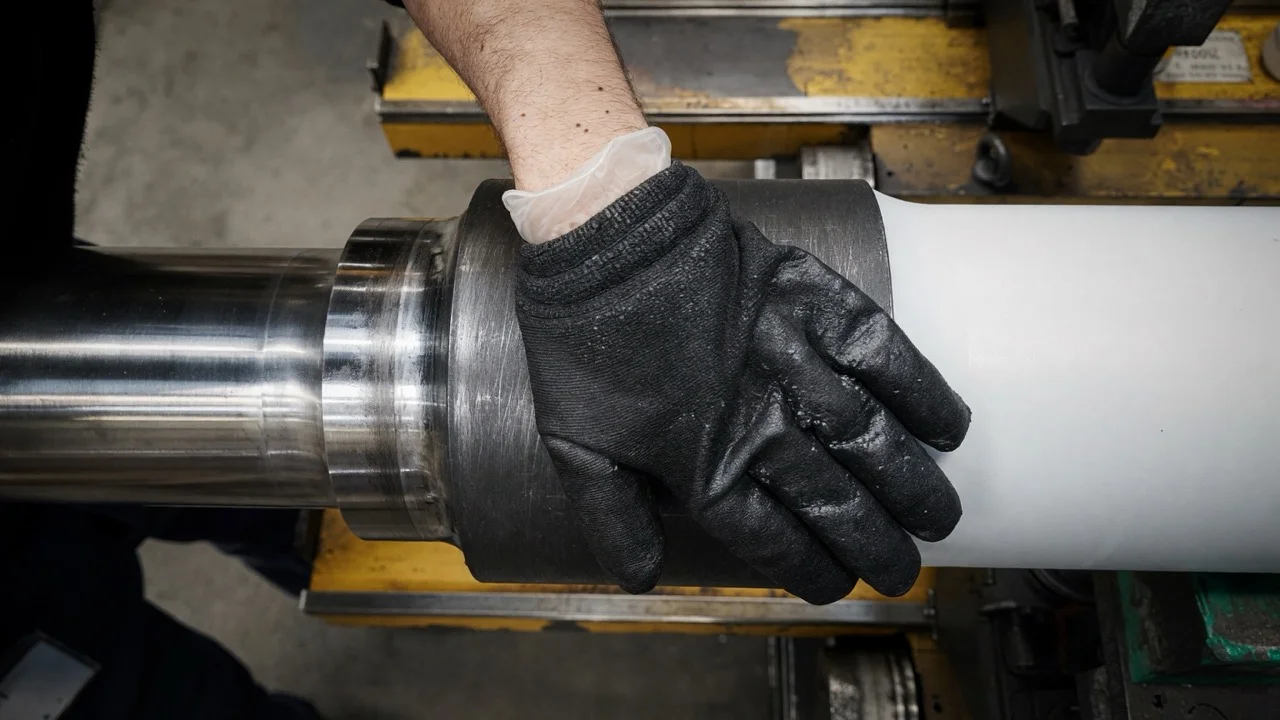
The contact areas of the wheel and the axle are cleaned before application.
This operation allows for the removal of residues and contaminants from the surfaces intended for coupling, preparing the components for the subsequent assembly phases.
Application of the assembly paste
MOLYKOTE® G-N Plus is distributed on the surface of the axle intended to enter the wheel bore.
The lubricating paste must cover the assembly area uniformly. After application, the surfaces are wiped to remove excess product, without eliminating the film necessary for pressing.

Wheel positioning and pressing
Once preparation is complete, the wheel is positioned and aligned on the axle. Assembly continues through the progressive pressing of the wheel onto its seat.
In this phase, the anti-seize paste facilitates sliding between the surfaces and supports the coupling subjected to high stress.

Monitoring the pressing curve
During assembly, the system records the trend of the force in relation to the stroke of the press.
Monitoring the curve allows for verifying that the pressing proceeds according to the required parameters. At the end of the cycle, the set values are checked to confirm the correct execution of the wheel-axle assembly.

The role of anti-seize pastes in coupling
Assembly pastes are formulated to operate in conditions where conventional oils and greases might not offer adequate protection. In the fitting of wheels onto axles, they must simultaneously withstand:
- high loads;
- slow movement;
- high contact pressures.
Friction reduction
MOLYKOTE® G-N Plus has a low and constant coefficient of friction. This characteristic promotes sliding between wheel and axle during pressing and helps make the advancement of the components more consistent.
Protection from scoring and fretting corrosion
The lubricating film helps separate the metal surfaces during coupling; in this way, the paste helps prevent scoring and fretting corrosion, phenomena that can develop in the presence of high pressures and micromovements between the surfaces.
Performance under high loads
The load-carrying capacity of MOLYKOTE® G-N Plus is verified by a four-ball machine test according to DIN 51350.
MOLYKOTE® G-N Plus records a weld load of 2,800 N. The data expresses the result of the standardized test and confirms the suitability of the paste for applications characterized by extreme loads and low speeds.
All the properties of MOLYKOTE® G-N Plus for wheel-axle assembly
MOLYKOTE® G-N Plus is a PAO-based anti-seize lubricating paste intended for the assembly and running-in of metal parts.
In train wheel-axle assembly, it offers characteristics consistent with the process conditions:
- low and constant coefficient of friction;
- high load-carrying capacity;
- protection against scoring and fretting corrosion;
- non-metallic formulation;
- performance in the presence of extreme loads and low speeds;
- wide operating temperature range, from -25 °C to +450 °C.
The non-metallic formulation avoids the use of metal particles during assembly, while the solid lubricants help maintain the protection of the surfaces under the most severe assembly conditions.
Automatic lubrication in railway applications
Press-fitting wheels onto axles requires a controlled application of the paste on the surfaces involved.
In other repetitive lubrication points in the railway sector, automatic lubrication systems can instead help distribute defined quantities of product at programmed intervals, reducing manual interventions and maintaining a constant lubricant supply.
Controlling the process to protect wheels and axles
Train wheelset lubrication does not only consist of choosing a product. The result depends on the correct cleaning of surfaces, on the uniform distribution of the paste, on the removal of theexcess and on the process control of the curve of pressing.
MOLYKOTE® G-N Plus supports this process thanks to its low coefficient of friction, the ability to operate under high loads and protection against scoring and fretting corrosion.
To learn more about the application and evaluate the assembly paste best suited to your process conditions, contact our Mascherpa experts.