Key points of the article on Vactac
- Vactac is designed to position fabrics, cores, and auxiliary materials in vacuum infusion and RTM processes.
- The system uses hot melt adhesives based on polyolefin, free of solvents and VOCs.
- The Tec 7300 pneumatic gun applies the adhesive through an adjustable pattern in spiral or fibrillated form, not by aerosol spray.
- The 100% solid content allows the entire product to be used, reducing waste and disposal.
- Vactac 300 and Vactac 350 are DNV approved and developed to limit the impact on the mechanical performance of the laminate.
In the vacuum infusion process, reinforcement fabrics, structural cores, and auxiliary materials must remain in the correct position during all phases of the lay-up. The adhesives used for positioning must ensure adequate tack without hindering the flow of resin or compromising the properties of the laminate.
Power Adhesives, manufacturer of Tecbond® adhesives and partner Mascherpa, has developed a solution specifically for this application. Vactac is a complete system combines hotmelt stickers specific for composite materials with the Tec 7300 pneumatic gun, replacing traditional spray solutions based on solvent e propellant.

Index
- Key points of the article on Vactac
- What is the Vactac system
- How Vactac works in vacuum infusion
- Why choose Vactac
- Vactac technology vs. aerosol spray adhesives
- Adhesives in the Vactac range
- The Tec 7300 pneumatic gun in the Vactac system
- Industrial applications of Vactac technology
- A more controlled positioning process
What is the Vactac system
Vactac is a hot melt solution developed to directly replace traditional adhesives spray based on solvent used for positioning of the reinforcement layers in vacuum infusion.
The Vactac system is formulated to position:
- reinforcement fabrics;
- fiberglass;
- structural foams in PVC and PET;
- structural cores in balsa;
- peel ply;
- release films;
- vacuum bags;
- tubing and other auxiliary elements.
The Vactac technology includes both the adhesive and the corresponding pneumatic applicator. Tec 7300 is not a separate solution from Vactac, but the tool through which the adhesive is melted, dispensed e distributed onto the material.
This integration between the product e applicator allows control of the amount of adhesive, pattern of distribution and flow rate according to the component geometry and process requirements.

How Vactac works in vacuum infusion
The Vactac adhesives are solid materials based on polyolefin. They are inserted into the Tec 7300 pneumatic gun in 43 mm format, brought to the molten state, and applied directly onto the materials to be positioned.
Unlike a solvent-based adhesive, Vactac does not solidify through the evaporation of liquid components. Bonding occurs through cooling and solidification.
The adhesive develops good bonding strength within seconds. Full strength may take longer, up to about an hour depending on the substrates and ambient temperature.
Open time and repositionability
After application, the adhesive maintains its tack for several minutes. This characteristic facilitates the positioning of large sections of material. Even after the initial bond, fabrics and reinforcements can be moved and repositioned without immediately losing the adhesive’s tack.
Only when the materials are pressed firmly together does the bonding complete.
The open time is particularly important in large composite structures, where the lay-up cannot be completed in seconds and operators must be able to correct alignments, overlaps, and geometries.
A pattern that allows resin flow
The hot melt adhesive is applied using an adjustable pattern that can be narrow, wide, spiral, or fibrillated.
Once solidified, the structure of the adhesive allows the matrix resin to flow through the reinforcements. The final infusion process can therefore proceed without the adhesive layer forming a continuous barrier.
Why choose Vactac
The primary function of a positioning adhesive is to hold the materials during lay-up. The comparison between different technologies, however, must also consider the safety, amount actually used, waste management of e influence on properties of the laminate.
Solvent-free and VOC-free formulation
Vactac is a solid hot melt adhesive, inert and free of organic solvents and VOCs.
Not being based on solvent evaporation, it does not release the volatile substances associated with traditional aerosol solutions. The adhesive is not dispensed in the form of small particles dispersed in the air. This reduces the requirements related to VOC management, such as air extraction, filter masks, and protective clothing specifically required for solvent exposure.
All normal safety procedures required for using an applicator working with high-temperature hot melt adhesive naturally remain necessary.
100% solid content
Aerosol adhesives typically contain about 20-30% adhesive. The remaining mass consists of solvent and propellant, components that are dispersed during application.
The Vactac slugs are instead composed of 100% adhesive. All the material inserted into the applicator is therefore used for bonding.
This characteristic allows:
- limiting waste;
- reducing the amount of dispersed material;
- eliminating used aerosol cans;
- reducing costs associated with container disposal;
- better controlling the actual consumption of adhesive.
Unlimited shelf life
The Vactac adhesives have an unlimited shelf life. They do not require special packaging, have no expiration date, and are not damaged by freezing.
These characteristics simplify inventory management and reduce the risk that the product must be discarded because it was not used within a certain date.
Mechanical performance of the laminate
A positioning adhesive remains inside the laminate. Its amount and distribution can therefore influence the interlaminar shear strength, indicated as ILSS.
The effect of the adhesive on laminate performance was evaluated according to ASTM standard D2344 on epoxy and polyester systems. The results show that increasing the applied weight causes a progressive reduction in ILSS. The amount must be sufficient to ensure bonding, but must remain within the validated limit for the process.
In comparative tests on epoxy resin, Vactac 350/300 showed a lower impact on mechanical performance compared to several aerosol technologies tested.
Vactac technology vs. aerosol spray adhesives
Traditional solutions for positioning use an elastomeric rubber dissolved in a solvent. The product is placed in a can, while a propellant allows it to be dispensed in the form of small droplets. After application, the solvent evaporates and the adhesive develops its bond.
Alongside traditional disposable cans, systems with adhesive in refillable canisters are becoming widespread, used to reduce the number of packages to manage in industrial applications. The refillable canister represents an evolution over the traditional can, but the principle remains that of a propellant aerosol solution.
Vactac uses a different process. The adhesive is solid, melted in the applicator, and solidifies by cooling.
| Parameter | Vactac | Propellant aerosol solutions |
| Technology | Polyolefin-based hot melt adhesive | Elastomeric rubber dissolved in solvent |
| Format | 43 mm hot melt slugs | Spray cans |
| Solid content | 100% | Approximately 20-30% in the aerosols indicated in the sources |
| Solvents and VOCs | Absent | Present in solvent-based formulations |
| Propellant | Absent | Necessary for dispensing |
| Application | Molten hot melt adhesive distributed with adjustable pattern | Small particles or droplets sprayed |
| Pattern | Narrow, wide, spiral, or fibrillated | Spray |
| Solidification | Cooling and transition to solid state | Solvent evaporation |
| Resin flow | Allowed by the pattern structure | Allowed by the discontinuous distribution of particles |
| Usable material | The entire slug consists of adhesive | Part of the mass consists of solvent and propellant |
| Additional requirements | Compressed air and electricity | VOC management, respiratory PPE, and container disposal |
| Airborne particles generated by the adhesive | None | Present during spraying |
| Packaging waste | No aerosol cans | Cans or containers to manage |
| Shelf life | Unlimited | Not indicated in documentation |
| Indicative cost per m² | € | €€ |
| ILSS on epoxy at 10 gsm | 40.51 MPa | From 20.79 to 36.29 MPa in tested alternatives |
| ILSS on epoxy at 20 gsm | 38.19 MPa | From 15.30 to 37.62 MPa in tested alternatives |
| ILSS on epoxy at 30 gsm | 34.60 MPa | From 12.18 to 25.65 MPa for products with available data |
Adhesives in the Vactac range
The Vactac range includes formulations developed for different materials, geometries, and processing times.
Vactac 300
Vactac 300 is designed to deliver high mechanical performance in infusion and RTM processes.
The formulation is transparent and helps reduce print-through, i.e., the visibility of the weave or pattern of the adhesive on the gelcoat. It is suitable for application using a narrow pattern or wide and for components where control of surface appearance is particularly important.
Vactac 350
Vactac 350 offers mechanical performance similar to Vactac 300, but features a pigmented formulation.
The color acts as a visual aid, helping the operator to:
- identify areas already treated;
- control distribution;
- verify pattern continuity;
- avoid insufficient or excessive applications.
Vactac 350 is also intended for infusion and RTM processes and can be applied with a narrow or wide pattern.
Vactac 300 and Vactac 350 are DNV approved and comply with class programs:
- DNV-CP-0083;
- DNV-CP-0089.
Other Vactac products
| Product | Key features |
| Vactac 200 | General purpose, high flow rate, and good adhesion and tack |
| Vactac 250 | General purpose, high flow rate, pigmented for easier visual control |
| Vactac 300 | High mechanical performance and transparent formulation against print-through |
| Vactac 350 | High mechanical performance and pigmentation to control coverage |
| Vactac 400 | Medium open time, suitable for difficult substrates, PP, PE, PET, balsa, and structural cores |
| Vactac 500 | Long open time, maximum tack, and use in automated fiberglass assembly |
| Vactac 740 | 15 mm stick with short open time for kitting, vacuum bags, and tubing |
| Vactac 780 | 15 mm stick with long open time for kitting, vacuum bags, and tubing |
The Tec 7300 pneumatic gun in the Vactac system
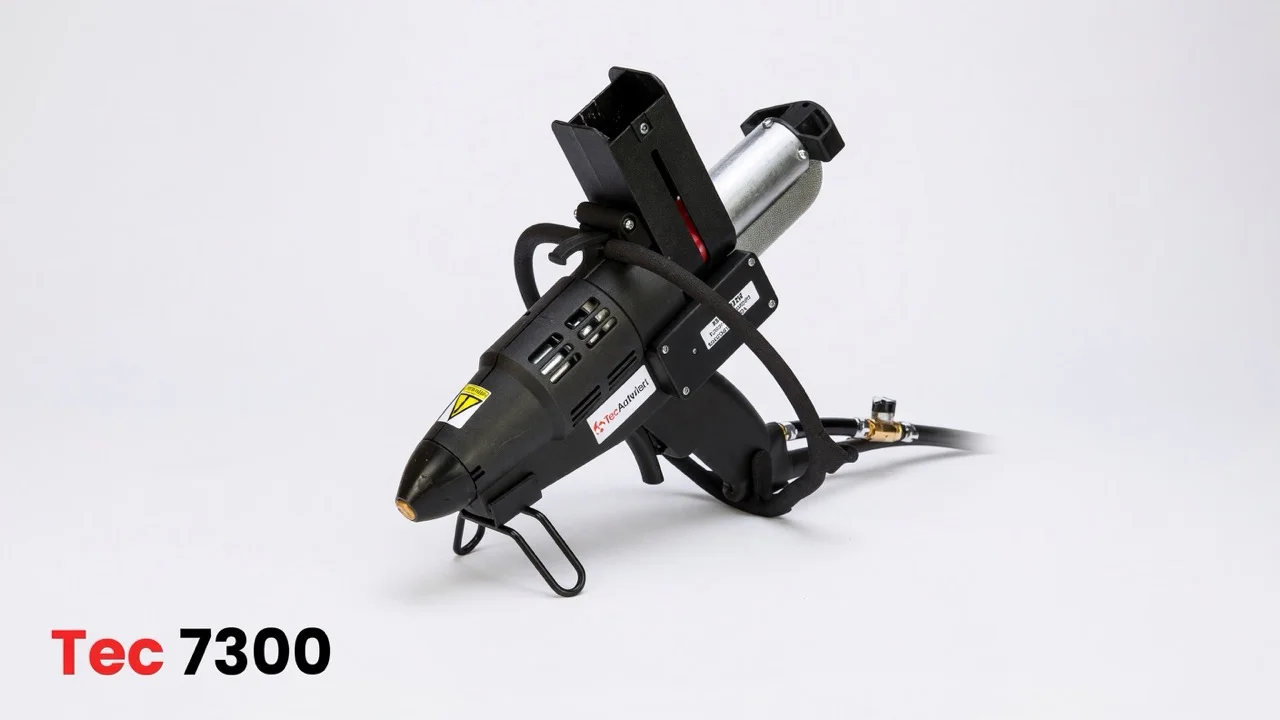
Tec 7300 is the pneumatic applicator for adhesives used to dispense Vactac formulations.
The Tec 7300 pneumatic adhesive gun features the following properties:
- power of 1 kW;
- operating temperature of 195 °C;
- electric power supply;
- operating pressure between 4 and 7 bar;
- adjustable flow rate between 0.3 and 1.0 g/s;
- melt flow rate up to 5.25 kg/h;
- standard nozzle of 1.5 mm;
- quick-load system.
After initial heating, the applicator keeps the molten material available, avoiding repeated waits for adhesive melting.
Pattern adjustment
On the rear of Tec 7300 there is a screw that regulates the air flow directed to the vortex. When the screw , is fully closed by turning it clockwise, the adhesive comes out as a bead and opening it progressively counterclockwise, increases the amount the air fed into the vortex. The pattern thus changes from a pronounced spiral to a more uniform and fibrillated distribution.
The adjustment also depends on the nozzle:
- red nozzle for a narrow pattern;
- black nozzle for a wide pattern;
- dedicated configuration for the spiral pattern.
The narrow and wide patterns, used with Vactac 300 and Vactac 350 ensure very good mechanical performance, good holding strength for tacking, and an adequate open time.
Industrial applications of Vactac technology
Vactac was developed to work in production processes for composite components, even when the lay-up involves large surfaces and numerous layers. This specification makes this technology useful for many industries where composite materials play a central role, including:
Marine and boat building
The marine sector represents one of the main applications of the technology.
Vactac has been used for over 15 years in the construction of boats. The system allows positioning fabrics and cores inside large molds, while maintaining the ability to correct the position before final tacking.
In this context, the following are particularly relevant:
- the extended open time;
- the repositionability of reinforcements;
- the visual control;
- the DNV approvals;
- the reduction of solvents and VOCs in production environments;
- the lower mechanical impact compared to aerosol alternatives.

Wind energy
The production of blades and other components for wind energy requires positioning fabrics and cores on very large surfaces.
Vactac can be used to tack reinforcements, PVC, PET, and balsa, maintaining an open distribution that allows the resin to flow through the lay-up during infusion.
Adjusting the pattern and flow rate allows adapting the application to the characteristics of different areas of the component.

Sandwich structures and composite panels
The Vactac system is also suitable for:
- composite panels;
- sandwich structures;
- fiberglass components;
- structural cores;
- parts made by infusion;
- RTM processes.
Vactac 400 is specifically suitable for temporary bonding of difficult substrates and cores in PP, PE, PET, and balsa, while Vactac 500 is suitable for automated fiberglass assembly.
A more controlled positioning process
A positioning adhesive must not only hold a fabric on the mold. It must maintain the materials in the intended geometry, allow the passage of the resin e limit its impact on performance of the laminate.
Vactac addresses these requirements through a single system consisting of hot melt adhesives formulated for composite materials and the Tec 7300 pneumatic gun.
Compared to aerosol propellant solutions, Vactac eliminates solvents and VOCs, uses a product with 100% solid content, and allows you to control flow rate and application pattern.
For more information on Vactac technology, contact our Mascherpa experts.